Tuesday, July 12, 2022

The Benign Prerogative - TWW S5E11


Original airdate: January 14, 2004

Written by: Carol Flint (2) 

Directed by: Christopher Misiano (18)

Synopsis
  • Criminal justice and all its quirks - pardons, mandatory minimums, sentencing guidelines - weigh heavy on the President's mind as the State of the Union address draws near. Charlie has a romantic entanglement. Toby sees how the polling sausage is made, in shopping malls. A decision made with good intentions ends tragically.


"I need to learn how to not be so ... how to keep things at arm's length."
"I hope not." 


The West Wing tries to show us politics as it ought to be. We see leaders who stand on principle, who make the tough choices, who do what is right even though it may not be politically wise. Well, the show tries to do that (think back to Let Bartlet Be Bartlet, or Inauguration: Over There, or any of the other examples of the administration doing the right thing instead of the easy thing), but at the same time, the demands of drama, the siren call of "balanced realism," and the desire to show these characters as human beings who do still make decisions based on caution and pragmatism can put something of a damper on all that optimistic enthusiasm. What happens in this episode is that that caution and pragmatism, while well-intentioned, ends up with somebody dying.

(Sidebar: why is everybody so worried about what it might look like if the President issues too many pardons? Why would they be terribly upset about a donor's son getting a pardon, particularly when they've done a great job of setting up the reasoning behind correcting these overreaching sentences? Heck, why should they balk at even a bold move like pardoning Lessieur ... because President Bartlet is never going to run for office again anyway. He's in the second year of his final term, he's already got an intransigent Congress fighting everything he does, he's not in the position to try to preserve any votes for 2006 - why not go big? Why not just do what he knows is right? Why is Leo holding him back? What are they "protecting"? Just my opinion - seems like an administration in its second term with an opposition Congress is already limited by the Republicans, no need to be putting more artificial limits on the things you can do without them. But I digress.)

Anyway, this episode delves pretty deeply into criminal justice and the federal judiciary and the rules of sentencing and the morality of the legislative branch taking away judicial discretion, as well as the power of the pardon and whether it's being used as it was intended. It's a pretty good show for the thinking viewer, even if it does cover some of the same ground as Take This Sabbath Day and Mandatory Minimums - but this is also a tremendous showcase for Janel Moloney's Donna, and she is outstanding in an emotional, deeply affecting performance.

It's also another episode that plays with time in its structure, in what I think is a pretty interesting way. Similar to What Kind Of Day Has It Been, we start with scenes immediately before the State of the Union speech, with snippets of people and events jumping out at us with no context, like Rena - the casually dressed staffer who picked up trash around the West Wing in Shutdown - suddenly reappearing and putting a stick of gum in Toby's jacket pocket:

"Extra gum, for your big night. It's okay ... we all get oral when we're nervous."

Where did she come from? And then Charlie, getting slapped by a woman right there outside the Oval Office:


That's a surprise. And then Donna, coming in to CJ's office, a stricken look on her face with no explanation for us as to what's happening:


Bam, flashback to three weeks earlier, so we can catch up on what the heck is going on here. It's a neat dramatic structure, well-used here, I think, because we really have no context at all to try to figure out what these opening snippets are supposed to mean. On the other hand, it's not quite as elegant as What Kind Of Day Has It Been, there's some frays around the edges - the end of the cold open isn't the end of the setup, for example: we roll the titles then get some more of Charlie and Meshell on January 20 before we flash back to New Years Eve. A more classically elegant construction would have hit the flashback right away. Likewise, at the end of the episode, there's actually quite a bit of time that passes from picking up at the moment where the flashback starts (just before everyone leaves for the Capitol and the speech) to the actual end of the episode (we skip over the President actually learning about Donovan's death, jump to after the speech, back at the White House). That isn't as much of a flaw of the structure, though, in my opinion, but ... it could have been tighter.

I'll save the main storyline for last, because we can cover the others fairly quickly. Charlie starts out at a New Years' Eve party at Angela's, where he bumps into a cute young budding reporter named Meshell Anders. They hit it off (really, really well, apparently, as we're able to surmise later in the episode they slept together that night), and Charlie is so enamored with her that he brings her around for a private tour of the West Wing. It's at that point she reveals she's not just an intern for the Afro-American, but she's joining the White House press corps as an off-camera entry-level reporter for NBC.

For some reason, Charlie blows up at that. I mean, yeah, I get that he feels betrayed that he showed her all the backroom sights of the West Wing and set her up for a young-intern-press-camp thingy with CJ that she's obviously now overqualified for - but his reaction just seems overblown. I think writer Carol Flint tries to make a tie-in to Charlie being protective of the President as a father figure ("He's not just the President") and somehow he thinks he's letting Bartlet down by giving this network reporter some extra access, but it doesn't play.

Anyway, he gets mad, won't return her calls, she comes to the White House on SOTU night with her aunt's friend Angela, ignores Angela's warning to not see Charlie, sticks her head in his office, he coldly refers to her as "Ms. Anders," she slaps him. That's about it. She says she understood Charlie when he said President Bartlet wasn't just the President, but he says, "See you around," and that's the end of that. Not the greatest storyline of all time, by far.

Joey Lucas is coming by to help do some polling for the SOTU. It's not that they need help crafting the speech - Toby basically has it finished three weeks early - but to find the tone, the delivery style, the "punch" to really make it land (and, for Toby, he still wants to find that key paragraph that the entire address can be centered around).

Josh is kind of intrigued - he was interested in getting together with Joey in prior episodes like 20 Hours In L.A. and Mandatory Minimums and Bartlet's Third State Of The Union - and as he and Donna talk about her coming he's priming himself to maybe ask her out (Donna, however, has already run into Joey and knows more about her current situation than Josh does):
Josh: "I heard she was seeing someone."

Donna: "Yeah, I think she is."

Josh: "Did she say she was seeing someone?"

Donna: "No."

Josh: "So who knows? Maybe the time is ripe."

Donna: "Maybe not so much."

And then Joey calls out from behind: "Josh!"


 A very pregnant Joey. Josh's reaction is priceless:


Joey is heading out to shopping malls around the country to test out some different deliveries of the speech, and Leo sends Toby out with her because, well, the speech is done and Toby doesn't have anything better to do. Heading out with him is Rena, that staffer out of nowhere that helped during the government shutdown, and we discover Toby has hired her as his assistant. So that's why we saw her at the start of the show.

Toby's not thrilled with the direction of the polling - Joey is using it to find out "purchasing intent," treating administration policies like selling washing machines - but at a stop in Bradenton, Florida, he follows a man who storms out of the mall in the middle of filling out his paperwork ("Keep your ten bucks!").

Toby queries the guy about what has upset him, and he has an answer (one that reverberates to today's politics, at least to me ... come on, guys, you're in office while all these horrible things are happening to our norms and our rights - do something!):

Man: "What is it you want, you want me to feel like I'm part of the club?"

Toby: "Yeah, maybe."

Man: "Well, you won't do it with words. Not words that are pre-tested, reworked, sanded down and wrapped in a bow. Hey, you wanna impress me? Do something. Talk's cheap, pal."


That leads Toby to happily reflect, "That's my guy. That's who I write for." Unfortunately that plotline doesn't go anywhere else, we don't actually see Toby incorporating "his guy" into the writing of the State of the Union.

CJ keeps getting calls from her old boyfriend Ben (we discovered in Constituency Of One that they lived together for six months; now we find out he's a park ranger in Alaska), but that's about the extent of that. Although I do love Carol's reaction when CJ tells her what to do "if he calls again."

"If?!?"

Leo is also dragging his feet about accepting an invitation to join the Bartlets for Presidents Day weekend - we eventually find out his ex-wife Jenny's wedding is that same weekend, and he wanted to give Jed and Abbey an out so they could attend. But that's not what they want to do, they'll send the couple something nice ("a juicer, maybe." "Encourage Howard to lose some weight"), but Leo is who they want to spend time with.

Now, the big story. Congress has passed an anti-kidnapping bill, a big priority for the administration after the events concerning Zoey the previous spring (Commencement through The Dogs Of War), but there's a catch. Republicans have attached an amendment with even more wide-ranging mandatory sentencing minimums that tie the hands of federal judges in handing down punishments. That's something President Bartlet is strongly against; and when discussions with Abbey spur him to consider handing out some pardons and commutations, the issue of prison sentences that don't fit the crimes comes to the forefront.

As I said in my intro, there's some really good discussions about mandatory minimums and the inherent unfairness of strict sentencing rules here. At one point, after Leo tells Josh they're not talking about adding to the SOTU, they need to hammer out the pardons, the President lays it all out there:

President: "Our judicial system is predicated on an individual's right to a fair trial. But how individual is that process? If a 258 box grid seals your fate before you even set foot in front of a judge, a federal judge that my office has invested considerable effort in selecting, who is then constrained from exercising basic common sense while 29-year-old prosecutors who make their bones on their win-loss record hold the only discretion in the whole system?"

Bringing Leo around to realize that, okay, maybe they should add something to the speech: 

Leo (to Toby): "You taking notes?"

Toby: "Yeah." 

Donna gets the brunt of the dirty work. After all the requests for pardons have been narrowed down to 36 prisoners, all model subjects who wouldn't seem to cause any uproar for having their sentences commuted, she hauls the files into Josh's office:


Josh (as Donna places the pardon case files on his desk): "Don't leave 'em here."

Donna: "You said you wanted to take a look."

Josh: "I said we wanted to take a look, and when I said we --"

Donna: "You meant me."

(She begins to pick up the files)

Josh: "I'll help you ..."

Donna: "Thanks."

Josh: "... move 'em."

Donna: "Right." 

So she has to go over the files, she has to read all the stories of families torn apart, lives interrupted, people paying a high price for honest mistakes:


 And it gets to her.

Donna: "These 36 people haven't been culled enough, out of thousands of applicants? Forget that they've all been imprisoned for at least five years."

Josh: "For committing crimes."

Donna: "Still, they submitted petitions to Justice that took at least two years to inch from desk to desk, none of them are violent - although by now I would be - none of them have priors - a lot of them, their judges spoke at their sentencing against the harshness of what they had to impose."

Josh: "Doesn't mean we stop scrutinizing."

Donna: "Scrutinize away. You tell me, do we toss out Daisy Aimes, mother of three with two jobs and a boyfriend who stored a kilo in her closet? She's done eight years and is facing eleven more, that's more than rapists and child molesters get. There's about fifteen Daisys in here. Do we pick three?"

Then, just to make things even more complicated, a couple who have been big donors to Vice President Russell stop by, not just to visit, but to beg for a pardon for the wife's son. Donna and the pardon lawyers hadn't made the connection because the last names were different, but Donovan Morrisey, who has spent seven years in Leavenworth already after sending LSD via FedEx as a high schooler, is Mrs. Kahler's son. Leo and the President are particularly concerned about the optics of issuing a pardon to such a big donor, right on the heels of vetoing the anti-kidnapping bill with the added mandatory sentencing minimums.

Donna, again, is the one asked to deliver the final plea to the President.

Donna: "I promised Mrs. Kahler I'd do my best."

President: "What did she say?"

Donna: "She said her son Donovan made a terrible mistake when he was still a teenager. Doesn't excuse anything, but her divorce was very hard on him. By the time he went to trial the shock of his arrest had given their family a wake-up call. Donovan had completed a drug treatment program, finished high school and been accepted to college. Unfortunately the guidelines prevented the judge from considering any of these things. She said after Donovan finished one year in prison - missed one birthday, one Christmas, one fly-fishing season - the other six years he spent in Leavenworth have been a frozen hell. Her words, a frozen hell. She wasn't, she ... (pause) She's someone who copes, but ... she said if it would make a difference, she'd get on her knees. She begged for your mercy. That's all."

(Just a heart-wrenching performance from Janel Moloney. She's so great.) 

Donna leaves the room. Bartlet contemplates the issue. Finally, he decides:

President (haltingly): "Take him ... take Donovan off the list."

Leo: "You can pardon him in the spring. After the dust settles."

Our timeline arrives back at where we were at the beginning of the episode. We see some different angles of scenes, some added shots - and Donna receiving a telephone call that sends her on that fateful trip to CJ's office.


CJ: "What's wrong?"

Donna: "I just had a call from Anne Kahler, Donovan's sister. He killed himself."

CJ: "Who's Donovan?"

(Oh, that's right, CJ wasn't in on any of the pardon discussions, she doesn't know the story.)

Do they tell the President before he goes to the Capitol for the State of the Union, do they risk throwing him off his game? Well, of course they have to ... but as the staffers wait outside the Oval, the sight of Leo and the Bartlets happily chatting, unaware of the tragedy that's just happened, causes an upset Donna to turn and run. CJ sends Josh after her.


Of course it's Josh, we've been watching Josh and Donna for almost five years now, we know the bond they have, the devotion they carry for each other, even if their love remains unspoken for the time being. Josh catches up to her outside, and it's a touching conversation that speaks volumes:


Josh: "It's not stupid. You met them. They got to you."

Donna: "I need to learn how to not be so ... how to keep things at arm's length."

Josh (quietly): "I hope not."

And after the speech, another triumphant Bartlet State of the Union (it seems), the President knows Donna needs to be acknowledged, recognized, seen for all she's done over the past few weeks, even though tragedy struck right at the end. As she guides the special guests into the Mural Room and introduces the President to them, he's talking to Donna just as much as he is Candy, the prisoner whose sentence he'd commuted earlier that day.

Candy: "I can never repay you."

President: "Oh, yes, you can. You got the second chance you deserve, but it's also a heck of a burden. If you screw up again you don't just hurt yourself and your family - you damage me and worse, you hurt all those prisoners still hoping for the fair shake most of them won't get. (pause) Am I right, Donna?"

Donna: "Yes, Mr. President."

President: "Ms. Holmes, you need to take your life in your hands and make sure that none of those left behind are ever more deserving than you."

And as the President walks away, greeting the other special guests, the final shot gives us Donna, sad yet proud of an imperfect President who strives for better things.

Holmes: "Bless you all. It must be an honor to work for him."

Donna: "It is."


This episode gives us plenty to think about, lots to consider - but it's mainly a Donna episode, and I am totally here for it. No, Janel Moloney, it's not just Yo-Yo Ma who rules  ... you rule.


Tales Of Interest!

- This is the latest West Wing State of the Union episode, which has been practically an annual holiday event for the series. This one doesn't really focus much on the speech or the reaction or the trappings around it, though ... and I do miss the guy who called out "Sam Seaborn, everybody!" in the ballroom in at least two previous SOTU episodes.

- January 20 (which we see on a title card at the start of the episode), was a Tuesday in 2004, and was in fact the actual day President George W. Bush delivered his State of the Union that year (six days after this episode aired).

- We find out a bit more about Ben, who's been calling CJ since Constituency Of One. Apparently he's a park ranger in Alaska (Carol says "Ben, of the 907 area code," which is Alaska, and also calls him "Ben of Glacier Bay" - Glacier Bay National Park is located right by the state capital, Juneau, in the southeastern part of the state).

- We get Rena back, hired by Toby as an assistant after she helped clean up trash in Shutdown, but what happened to Ginger? Even Margaret is the one handling Toby's travel arrangements instead of Ginger. And speaking of missing characters, where has Ryan Pierce been since Disaster Relief? Was he sent home for the shutdown and just never came back?

- Interesting little tidbit about the Oval Office - in Shutdown Speaker Haffley made mention of  "Wyeth's intent" in the design of the Oval, meaning architect Nathan Wyeth who designed the room  when the West Wing was expanded in 1909 under President Taft. In this episode when Charlie is showing Meeshell around, he says the Roosevelt Room was the President's office "until FDR decided he deserved some sunlight, and built the Oval." That is kinda true and kinda not - the Roosevelt Room was made the President' office under Teddy Roosevelt in 1902, but as we know, seven years later Taft had the original Oval Office built. But, to Meeshell's point ... FDR did indeed oversee the construction of a new Oval Office in the 1930s, in an entirely different part of the West Wing from Wyeth's and Taft's Oval, and that is the Oval Office still used today.

- We are in a fictional universe, so the writers can use any numbers they want, which is proven by President Bartlet's lament to Leo about the number of pardons by recent Presidents. He says, "Recent Presidents have averaged 40, 20, and seven pardons a year. Why'd we get so stingy?" Given that two of the recent Presidents he means would be Lassiter and Newman (as seen in The Stormy Present), and there are at least a couple of other fictional Presidents in the West Wing line, any numbers he uses will work in that world. In real life, Ronald Reagan averaged about 50 pardons per year (406 over eight years), George H. W. Bush averaged about 20 (just 77 in his one term), Bill Clinton was back up near 60 (459 in eight years), and George W. Bush (who was still in office at the time of this episode) pardoned 200 sentences over his eight years, or 25 per year. 

- Here's a look at Gail's fishbowl for this episode. (There's a website that has tracked fishbowl appearances throughout the series, but somehow they skip this one, while also saying The Stormy Present fishbowl featured a flag-draped coffin ... I'm sorry, there's absolutely no way to make that claim from what we see on the TV screen.) This time it looks like a Post-It note and a red heart-shaped rock, which I'd infer relates to Ben's calls for CJ and Carol leaving messages.


- Why'd They Come Up With The Benign Prerogative?
President Bartlet says Alexander Hamilton called the power of the pardon "the benign prerogative." Indeed, in Federalist Paper 74 Hamilton wrote, "Humanity and good policy conspire to dictate, that the benign prerogative of pardoning should be as little as possible fettered or embarrassed."


Quotes    
Angela (convincing Charlie to meet up with Meeshell): "Don't cancel. Go late. A demanding job is a strong aphrodisiac."

Charlie: "Are you the devil?"

Angela: "It's folks who act like angels I worry about." 

-----

President: "I can't sign a bill that toughens guidelines and ties judges' hands then turn around next month and advocate judicial discretion."

-----

Toby: "No, I'm serious, I say the President announces his veto on the eve of the State of the Union, next morning his pardons become Act Two ..."

Josh: "Of, respect for federal judges."

Toby: "And prelude to his trip to the Hill that night. Which now is more than hat-in-hand begging Congress for a laundry list of priorities, the State of the Union becomes a few words about his agenda from the President who, as you've seen, is a busy guy."

-----

Charlie: "CJ, with the press, did you ever trust a reporter?"

CJ: "Is this the beginning of a joke?" 


Story threads, callbacks, and familiar faces (Hey, it's that guy!)
  • Gabrielle Union (10 Things I Hate About You, Bring It On, Deliver Us From Eva) appears as Meeshell, Charlie's love interest turned nemesis (sort of). Just don't call her Ms. Anders ...

  • The Washington Afro-American, the paper Meeshell writes for (and her family founded, we discover) is a real newspaper, founded in 1892.


  • Rena's back (Melissa Marsala)! We saw her in Shutdown, helping clean up the mess around the West Wing in non-professional attire while all the nonessential personnel were sent home. Now Toby has hired her as an assistant. He says "she compiled clippings at Energy" which still begs the question of why her job was considered "essential" and she wasn't sent home during the shutdown.

  • Joey Lucas (Marlee Matlin) returns. Joey first appeared in Take This Sabbath Day as a campaign manager, then as a pollster in 20 Hours In L.A., which also was the first time we saw a bit of romantic interest from Josh ("Gather ye rosebuds," Donna told him). She was last seen in Debate Camp. Matlin was pregnant with her fourth child, daughter Isabelle, when this episode was filmed (Isabelle was born in December, 2003).


  • The TV show Capitol Beat is seen once again. First mentioned in Pilot as the show where Josh popped off about Christian conservatives and nearly got fired, it has also been included in most of the other State of the Union episodes, particularly Bartlet's Third State Of The Union/The War At Home when it broadcast live from the White House.

  • We know Toby has been pushing for more responsibility in setting policy/directing the administration agenda since Han, and wanted Will to take over more of the speechwriting instead (like Sam used to do). Will's departure for the Vice President's office in Constituency Of One kinda set Toby up to not only set policy, but also write the damn thing himself.
  • CJ's former beau/current pursuer Ben was first brought up in Constituency Of One (she lived with him for six months, but they tend to get on each other's nerves after a while).
  • The President's moral dilemmas with pardons/commutations was previously depicted in Take This Sabbath Day; the ethical/political concerns with mandatory sentencing minimums was also a major plotline of (duh) Mandatory Minimums.
  • President Bartlet is seen wearing Notre Dame apparel not once but twice. Martin Sheen made it a requirement before taking the role that Bartlet be a Catholic and a graduate of Notre Dame.


  • Abbey's insistence on Leo coming up to the Bartlet home in New Hampshire over the holiday weekend - even skipping out on Jenny's wedding! - must mean she's over angrily blaming him for Zoey's kidnapping, which we saw in Jefferson Lives ("For God's sake, don't ask me to trust you").
  • Charlie's question to CJ ("Did you ever trust a reporter?") and her response ("Is this the beginning of a joke?") seems to ignore completely the relationship CJ had with Danny Concannon. Considering Danny disappeared for a couple of years after The Portland Trip in Season 2, then returned with the scoop about American involvement in the assassination of Shareef in Season 4's Holy Night before disappearing again after 7A WF 83429, maybe CJ has just forgotten about Danny entirely (although as I said, the last time we saw him in the press room was less than a year prior to this episode, in the spring of 2003). Naturally it's all the phone calls from Gentle Ben going straight to her head, too.
  • Charlie mentions to Angela that he had to cancel on Meeshell Sunday because of "an attempted coup in Saudi Arabia" - we saw a pro-democracy uprising in that country in the previous episode, The Stormy Present, but considering Charlie was on Air Force One with the President traveling to President Lassiter's funeral, he must not have meant that event. Things seem a bit unsettled in Saudi Arabia, I guess.
  • Just an odd little oddity of a connection: while the big overall themes of sentencing guidelines, pardons, and mandatory minimums are obvious reflections of the prior episodes Take This Sabbath Day and Mandatory Minimums, those entries also have a connection regarding this episode's humorous quick take on Josh's possible romantic interest in Joey Lucas. Joey's first appearance on the series came in Take This Sabbath Day; she also set up temporary shop in the White House in Mandatory Minimums, flustering Josh a little who wore his "Tuesday suit" to impress her and gifted her with a White House mug.

DC location shots    
  • None.

They Do Exist! It's The Real Person, or Thing    
  • Jed and Abbey leave early from the opera Turandot, and Jed throws in Puccini's name as well.
  • Gabriel Lessieur, the man Abbey is pushing Jed to pardon, is likely a stand-in for the real-life Leonard Peltier. President Bartlet says to Angela about Lessieur, "Not as sorry as you'll be if she (Abbey) gets started on what the FBI did or didn't do on that Indian reservation in 1977." CJ later says Lessieur was "convicted in the deaths of two FBI agents in North Dakota." Peltier was convicted in 1977 of killing two FBI agents on the Pine Ridge Indian Reservation in South Dakota two years earlier. Questions about the handling of evidence and other doubts about his conviction have come up over the years, particularly since a Freedom of Information Act request in 1980 revealed problems with the ballistics evidence, and ongoing calls for commutation of his sentence have been made on the White House since. As of this writing, Peltier remains in prison.
  • Likewise, Wallace Turner (the name Abbey brings up, someone who was pardoned by then-New Hampshire Governor Bartlet and apparently went on to murder after his pardon: Jed mentions "his victim's family") is likely meant to remind us of Willie Horton. Horton was a convicted murderer who, while not pardoned, was out of prison on a weekend furlough and committed assault, armed robbery, and rape. His furlough from a Massachusetts prison while Michael Dukakis was governor proved to be a major campaign issue in the 1988 Presidential election, which Dukakis lost to George H. W. Bush.
  • In the mall scenes there's mention of Mrs. Fields (cookies).
  • There's a Diet Coke can spotted on Donna's desk.


End credits freeze frame: The strategy session on pardons.


Previous episode: The Stormy Present
Next episode: Slow News Day

Thursday, June 23, 2022

The Stormy Present - TWW S5E10


Original airdate: January 7, 2004

Teleplay by: John Sacret Young (1)
Story by: John Sacret Young  & Josh Singer (1)

Directed by: Alex Graves (18)

Synopsis
  • President Bartlet attends the funeral of a former President as turmoil grips Saudi Arabia. Josh gets involved in a fight between North Carolina and Connecticut, and CJ tracks down a story about secret Pentagon mind control projects.


"I guess this changes things."
"I'm not sure it changes anything." 


This may be just my own opinion, but we are in a series of quite pedestrian West Wing episodes. When people talk about the quality of the show dropping off in Season 5, the episodes between Shutdown and The Supremes are exactly the ones they mean (and don't forget, The Supremes is immediately followed by what is widely considered one of the very worst West Wing episodes ever). Let's be frank, I think for an entire year - from Shutdown until the introduction of Sen. Vinick and Rep. Santos about nine episodes into Season 6 - the series finds itself floundering, on unsteady ground, and not sure about what stories it's supposed to be telling.

Even worse, and again just in my opinion, this episode is trying pretty hard to be a conservative-ish screed promoting American imperialism and decrying Muslim fundamentalism. The real world is two-plus years past the events of 9/11, but the impact of that attack on politics, foreign policy, and the attitudes of everyday Americans is still pretty raw. Okay, sure, we get the calming liberal point of view from President Newman, and President Bartlet remains unwilling to use military force or even much in the way of diplomatic coercion against our ally Saudi Arabia - although he's about to before the protests are subdued! - but the overwhelming impression left by the end of the episode comes down firmly on the side of "The United States knows best, the United States is the beacon of freedom and democracy in the world, and thus the United States needs to compel Muslim nations to embrace freedom (by force if necessary) since the struggle against global religious fanaticism is a battle for our survival just like the Civil War." At least that's what I get from Lassiter's obsession with the soil from American battlefields, the in-your-face comparisons to Lincoln and the issues facing him, and the final scene of Bartlet contemplating America's future while he gazes at the Lincoln Memorial.

Essentially I see the writers of this episode taking the high school student's question from Isaac And Ishmael - "why do they hate us?" - and instead of considering Josh and Sam and their earnest attempt to address that question, they ignore that completely and double down to say, "Yeah, why DO they hate us? We can't think of any reason ... guess the United States need to show them by force why we are right and they are wrong." I don't know, folks, talk me out of this, but this is the direction I see the episode heading.

(Say, whatever happened to the Bartlet Doctrine unveiled in his second Inaugural speech in Inauguration: Over There? President Bartlet declared it was now American policy to promote human rights anywhere in the world, by use of the military if it came to that, and immediately sent troops into Equatorial Kundu to stop killings and genocide. Seems to me the wish for democracy and free elections, especially in the face of imprisonment and beheadings for those calling for change, would qualify - but then again, Equatorial Kundu isn't exactly Saudi Arabia, in military capabilities, alliances with the United States, or in oil reserves. Given the history of the doctrine with Kundu, I'd daresay the Saudi government's use of force against pro-democracy protests would be even more of a justification for American military involvement ... instead Bartlet sees that as a reason to back down and leave well enough alone.)

We can tear through the plot fairly quickly. A former Republican President, Owen Lassiter, has died, and President Bartlet and what I can only assume are the other two surviving Presidents (D.W. Newman and Glenallen Walken) fly across the country to attend the funeral. Events are complicated by pro-democracy uprisings in Saudi Arabia, putting Bartlet and his administration in kind of a sticky bind between promoting freedom and keeping a good relationship with the oil-producing monarchy in charge.

Bartlet and the other Presidents have some good back-and-forth talks about what to do, with Walken on the side of American power stepping in to back the protesters and force regime change, and Newman urging caution and reminding the President of the failed outcomes of such attempts in the past. We do get a neat scene with three Presidents, past and present, all sitting together on Air Force One discussing foreign policy:


As things are getting tense in the Middle East, President Bartlet makes the decision to move naval forces into the Persian Gulf as a sign of support for the democratic protesters, and is ready to give the Saudi royal family an ultimatum. But then, before the United States goes all-in with its big stick, the previously peaceful protests turn violent (perhaps at the instigation of government provocateurs?), government forces crack down, and the uprising is thwarted.

As that's happening in Saudi Arabia, President Bartlet has a few minutes with President Lassiter's widow, in the Oval Office mockup built as part of the Lassiter Presidential Library. A library that's apparently been closed to the public for some time, since Lassiter had been living there in his hospital bed before his death.


Lassiter had also spent his post-White House days traveling to battlefields where American soldiers had fought, collecting soil from the places where American blood had been shed. A bit obsessive, I think, and another real downer for people who may have been visiting the Lassiter library:


(Was Lassiter the one-term Republican who preceded Bartlet? We don't know for sure, but given that we only see Newman and Walker as other living Presidents, it's most likely. So all the collection of all the soil in these jars has happened just since Bartlet took office and replaced Lassiter in January 1999.)

Mrs. Lassiter gives President Bartlet a letter, one we saw Lassiter writing at the beginning of the episode, a sort of manifesto about the American ideal, its responsibility to stand firm in the face of Islamic fundamentalism - a real conservative screed. It ends with this:


Which seems to say Lassiter's point is Lincoln's fight to save the Union and America itself is reflected today in the global struggle against religious extremism. Huh. President Bartlet, back in Washington, seems to think Lassiter had a point, as he does exactly what he had been asked to do.


I don't know. I don't buy the connection between freedom in Saudi Arabia and Lincoln fighting the Civil War. Saudi Arabian democracy advocates need their own Lincoln, not the military might of the United States kicking out the monarchy and roiling the Middle East even further into anti-American outrage. Perhaps Bartlet saw Arujunah as that Lincoln, and hoped to provide him enough support to survive. But I'm no foreign policy expert.

Otherwise Josh finds himself in the middle of a battle between North Carolina and Connecticut over a stolen copy of the Bill of Rights (based on a real event), but his primary contribution is a faltering "Go Whalers." We do get to see Josh's facial reaction to getting schooled by the President over knowledge of Lincoln trivia when they're all trying to get to Ford's Theatre:


There's another clever scene as the staffers are preparing for the Ford's Theatre event - Toby, who is hiding from the President and his Lincoln quizzes, is staked out on CJ's office sofa


as a distracted CJ has her eyes on the TV and starts to change her clothes ... until Toby makes a remark about something on the television.

CJ: "Was there something you wanted?"
Toby: "World peace?"

Those two have such a good relationship, you can tell there's history and respect and a real mutual understanding between them.

CJ also finds herself tangled up in news of a possible Pentagon mind-control project, which results in her meeting with a DARPA scientist (Dr. Milkman, of course) who gets her all riled up about medical records and privacy and the study of a person's gait ... but you know what? None of these stories really pay off, and that includes the A plot.

The mind-control thing just kind of ends with a conversation between CJ and Josh:
Josh: "Does the press have the story?"

CJ: "Huh?"

Josh: "The mind-control story, didn't you say it was going to break?" 

CJ: "Yeah."

Josh: "So the story breaks, and the public has roughly the same reaction you're having. No more mind control, no more sifting."

The Bill of Rights theft comes to a conclusion off-screen, as Josh tells CJ everything got worked out, no problem. And as I've gone over above, the storyline about democracy in Saudi Arabia ends pretty much exactly where it began, with President Bartlet's eventual decision to back the protests coming just late enough to not make a difference. To me, it's all very unsatisfying, with all the stories just - ending.

Maybe that's what John Sacret Young was after, to illustrate the frustration and futility and how all the best-laid plans and good-faith efforts in the world don't always pay off. But I mean, come on, that's not what we watch The West Wing for, is it? Particularly when those themes are as poorly defined and clunkily put together as what we get in this episode. It's little more than a West Wing curiosity of the time, a time capsule of George W. Bush-era American foreign policy - nothing more than that.

Well, a drunk Toby singing Suicide Is Painless while Charlie takes his whiskey bottle away is pretty good, but it doesn't really make up for the rest.


Tales Of Interest!

- This episode is the landmark 100th of the series. Typically, 100 episodes is the point at which a TV series becomes attractive for syndication, where it can be sold to distributors who air them on individual TV stations (or niche cable channels) rather than on the network schedule. As a matter of fact, the Bravo cable channel started with reruns of The West Wing in the fall of 2003, just as Season 5 started on NBC, so a syndication deal had already been done. I don't know if the series was ever syndicated to individual stations - one-hour dramas aren't nearly as attractive to TV stations as half-hour sitcoms, which fit their schedules better - but I do know episodes were shown on the TNT cable channel leading up to the 2020 election. Of course, with streaming services coming to the forefront, The West Wing had a long run on Netflix before moving to the HBO Max service in late 2020.

- There is no "previously on The West Wing" introduction to this episode with scenes from earlier shows, just the drum roll with the flag and then immediately to the title card. This usually indicates a stand-alone episode that doesn't tie in to earlier storylines, which is pretty much the case here. It's also rare - with the obvious exceptions of Pilot (when there were no previous scenes to show) and Documentary Special, it's only happened three times before now: Take This Sabbath Day, Isaac And Ishmael (which is non-canon and doesn't technically exist in the West Wing timeline), and The Dogs Of War.

- Speaking of pedestrian hackery ... having a Secret Service agent in the White House calling out "The President's dead" into his wrist microphone as he moves past Leo and Mallory in the hallway is just an outlandishly inconceivable device to throw a scare into the audience. Come on, John Sacret Young - I don't know if this is beneath you, but it's far, far beneath even an average West Wing teleplay. This is the reason the Secret Service uses code names for the figures they protect, like "Eagle" for President Bartlet or "Bookbag" for Zoey or "Flamingo" for CJ ... so they don't refer to every President, past and current, as "the President" and give Leo a heart attack (which is especially cruel considering Leo's upcoming storylines, as well as John Spencer's fate).


- I've mentioned the possible West Wing universe Presidential timeline before, particularly the fact that there's never been a reference to a real-life President since Kennedy or LBJ (only a couple of loose references to LBJ, and only two mentions of Nixon, neither one that clearly indicate he was President). The fact we find out about two former Presidents here - Lassiter and Newman - doesn't do a lot to clear things up. We know from The Short List and comments by retiring Supreme Court justice Crouch that a Republican preceded Bartlet in office ("I waited for a Democrat. Instead I got you"). We also know from In Excelsis Deo that Leo served as Secretary of Labor in a Democratic administration in 1993 (when he entered rehab), which means the Republican in office before Bartlet was a one-termer. We know from Separation Of Powers that there have been six administrations and 22 Congresses since Chief Justice Ashland was named to the Court in the early 1960s, although that math still doesn't work out unless you ignore either Bartlet or Kennedy (and as Josh mentions, no one is counting Walken's two-day administration):
Bartlet: elected 1998-present

Unknown Republican: elected 1994-98 (could this be Lassiter?)

Unknown Democrat: possibly two terms, elected 1986-94 (could this be Newman? The fact Toby says he'd "voted for you a couple of times" could indicate he served two terms. However, Leo - who we know served in this President's Cabinet in the early 1990s - makes no mention of any relationship with Newman. It's a puzzler ...)

Possibly another two-term unknown elected 1978-86

Possibly another two-term unknown elected 1970-78

Possibly another two-ish term unknown (LBJ, perhaps?) serving from 1963 to 1970 (and yes, I realize there's a shift between election years from real-life to the West Wing universe)

Kennedy: elected real-world 1960, assassinated 1963

I've speculated before about the timeline changing at Nixon, with his resignation in 1974 bringing about new elections called that year to reset the electoral timeline as we see it in the series. That would mean a Kennedy administration until 1963, LBJ from 1963 to 1968, Nixon from 1968 to 1974 ... then there would have to have been at least three Presidents between 1974 and the one-term Republican serving before Bartlet (there's five terms in between there, that means at least three different administrations). That makes six full administrations between Kennedy and Bartlet, which doesn't at all agree with the count for Chief Justice Ashland in Separation Of Powers. So, I dunno.

- The story of North Carolina's copy of the Bill of Rights, its theft by a Union soldier in 1865, and its mysterious whereabouts until the FBI got involved and recovered the copy in 2003 is pretty fascinating. Although unlike how it's described in this episode, Connecticut plays no role in the actual story. The document turned up on a businessman's wall in Indiana in 1897. That family refused to surrender it until they offered to sell it back to North Carolina in 1925, but the state refused to pay for what they considered their own stolen property. Descendants offered to sell it again in 1975, were again rebuffed, and it was eventually sold to an antique dealer in 2000. When he tried to sell it to the National Constitution Center in 2003 (claiming he did not know the document's origin), the FBI got involved in a sting operation to seize the copy. It would take another five years of court battles before North Carolina got full ownership rights.

- We can see just a bit of Gail's fishbowl while Dr. Milkman is talking about DARPA, but we can't see if anything is in there.


- Why'd They Come Up With The Stormy Present?
As President Bartlet and Walken reminisce about President Lassiter, Walken recalls a time Lassiter was quoting Lincoln's second inaugural address and Bartlet fills in the line: "The dogmas of the quiet past are inadequate to the stormy present." Lincoln was, of course, referring to the Civil War; Bartlet draws a parallel to the pro-democracy protests in Saudi Arabia, and relations with the Arab world in general. 


Quotes    
CJ: "Is there a reason you're following me?"

Toby: "Do I need a reason?" 

----- 

CJ: "Leo, I got a question yesterday ... tell me we're not conducting mind-control research at the Pentagon."

Leo (deadpan): "We're not conducting mind-control research at the Pentagon."

CJ (staring back intently): "You're not doing it on me right now?" 

-----

Carol: "There's a man in your office."

CJ: "Okay."

Carol: "I didn't see him come, I turned around, and he was there."

CJ: "A man in my office. (Carol nods) Is he dashing?"

Carol: "Not how I'd describe him."

-----

Toby: "Without strong guidance popular elections could be a one-time event."

President Newman: "Strong guidance ... you think we should colonize?"

Toby: "No, I think we should run away, as fast and as far away as we can."

-----

Toby: "I've been walking up and down these aisles, looking at these old men - these great and terrible old men - and thinking, a prosperous, free, and democratic Saudi Arabia is something to wish for. But the men on this plane spent the better part of the late 20th century trying to play God in other countries, and the regimes they anointed are the ones that haunt us today."


Story threads, callbacks, and familiar faces (Hey, it's that guy!)
  • The fantastic actor James Cromwell (Babe, Star Trek: First Contact, Succession, on and on and on) appears as President D. Wire Newman.

  • The equally wonderful and instantly recognizable Stephen Tobolowsky (Ned Ryerson in Groundhog Day, The Goldbergs, Mississippi Burning, on and on and on) shows up as DARPA scientist Dr. Milkman.

  • And there's Bellamy Young (Scandal, Scrubs, We Were Soldiers) as the North Carolina representative trying to get the state's copy of the Bill of Rights back. Young's role on Scandal is just a part of the West Wing to Scandal actor pipeline (see: Joshua Malina, Jeff Perry, Liza Weil, etc, as well as character names Huck and David Rosen), as Scandal creator Shonda Rhimes is a big fan of The West Wing.

  • Libby Lassiter is played by Diana Douglas, who doesn't really ring a bell with me but was in over 800 episodes of the daytime drama Love Is A Many-Splendored Thing in the early 1970s. She also has been seen on The Waltons, The Paper Chase TV series, and has a blink-and-you'll-miss-her scene as the mother-in-law of Steve Martin's character in Planes, Trains and Automobiles. Fun fact: Douglas was married to Kirk Douglas from 1943 to 1951, and is Michael Douglas' mother.

  • A nice callback to Glenallen Walken's time in office (played by John Goodman) when President Bartlet invoked the 25th Amendment during Zoey's kidnapping (Twenty Five through The Dogs Of War). While only President for a couple of days, he's included in President Lassiter's funeral arrangements.

And Bess!

  • We haven't seen Secretary of Defense Miles Hutchinson for a bit. He's back in the Situation Room.

  • Speaking of not seeing someone for a while, here's Leo's daughter Mallory, played by Allison Smith (the longest running Annie on Broadway). We met her first in Pilot, she had a flirtatious relationship with Sam in Season 1, but we haven't seen her around since Twenty Hours In America Part Two.

  • West Wing veteran director Alex Graves uses the tried-and-true camera-spinning-around-characters-talking technique quite a few times.
  • Col. Gantry is still the pilot of Air Force One, last mentioned in Disaster Relief and previously heard as the pilot in a couple of earlier episodes. 
  • Leo is still wearing his wedding ring, despite his wife leaving him in Five Votes Down and his divorce coming through in The Portland Trip. It makes the scene where Mallory tells him about Jenny getting remarried even more poignant.

  • Meanwhile, Toby is not wearing a wedding band. At the start of the series Richard Schiff, unbeknownst to Aaron Sorkin, wore a ring as part of the widower backstory he created for Toby. Sorkin took that actor's choice and changed it into the storyline of Toby's former marriage to Congresswoman Andy Wyatt. Perhaps Toby has given up the ring as part of his pursuit of Andy and attempt to get her to remarry him.

  • Also, Toby's insistence that the United States should break off ties with Muslim nations like Saudi Arabia - "we should run away, as fast and as far away as we can" - is quite a change from his rant in Night Five that American democracy needs to defeat Islamic fundamentalism ("They'll like us when we win!").
  • President Newman brings up Bartlet's "illness" and the angry reactions to the announcement both he and President Lassiter had. We discovered President Bartlet was hiding his multiple sclerosis in He Shall, From Time To Time ..., and watched his staff learn the news throughout late Season Two until he revealed it to the nation in Two Cathedrals.


DC location shots    
  • The final shot, with President Bartlet somberly considering President Lincoln's legacy at the Lincoln Memorial.


They Do Exist! It's The Real Person, or Thing    
  • Several actual poems and songs are quoted, from The Charge Of The Light Brigade ("into the valley of death rode the 600") to The Battle Hymn Of The Republic ("mine eyes have seen the glory of the coming of the Lord") to the M*A*S*H theme song Suicide Is Painless ("it brings on many changes").
  • When CJ asks about Pentagon mind control experiments, Toby responds with MK-Ultra, which was a CIA project that used drugs, electroshocks, and other forms of physical and mental torture in an attempt to manipulate subjects' mental state and brain function. The project was officially ended in 1973. The 1959 novel and 1962 film The Manchurian Candidate also is brought up in the discussion.
  • Josh mentions the Whalers a couple of times, meaning the Hartford Whalers, a WHA/NHL hockey team that played in Hartford, Connecticut, from 1974 to 1997. The team then moved to Raleigh, North Carolina, and became the Carolina Hurricanes.
  • DARPA (and ARPA) are topics of discussion - originally founded as the Advanced Research Projects Agency and later renamed the Defense Advanced Research Projects Agency, DARPA's research can claim at least partial credit for technological advances including the Internet, GPS, drones, weather satellites, and the Moderna COVID vaccine. 
  • President Lassiter is compared to Attila the Hun. Toby refers to Lassiter's elderly administration members coming to the funeral as "Madame Tussaud's" (wax museum).
  • President Bartlet mentions the famed portrait artist Gilbert Stuart (one of his portraits of Washington is hanging on the Oval Office wall).

  • Leo says he has plans to meet Mallory at Oberdorfers. It sounds like he's taking her shopping, yet ... There was a U.S. District Court Judge for the District of Columbia named Louis Oberdorfer from 1977 until his death in 2013 - perhaps a family friend of Leo's? It's an interesting name to drop in to a West Wing script, in any event. There actually was a Christian Science Monitor article from 2002 that made a comparison based on moral relativism between President Bartlet's decision to kill the Qumari Defense Minister and a case before Judge Oberdorfer involving Exxon and its employees' rights violations in Indonesia, so somebody had already linked Oberdorfer and the TV series.
  • President Bartlet includes FedEx in his list of options to get a message to Crown Prince Bitar (along with fax and carrier pigeon).
  • Al-Jazeera is mentioned by Leo. CNN comes up a few times, and in addition to the by-now-familiar view of the MSNBC logo we get a rare glimpse of the CNN logo as well.


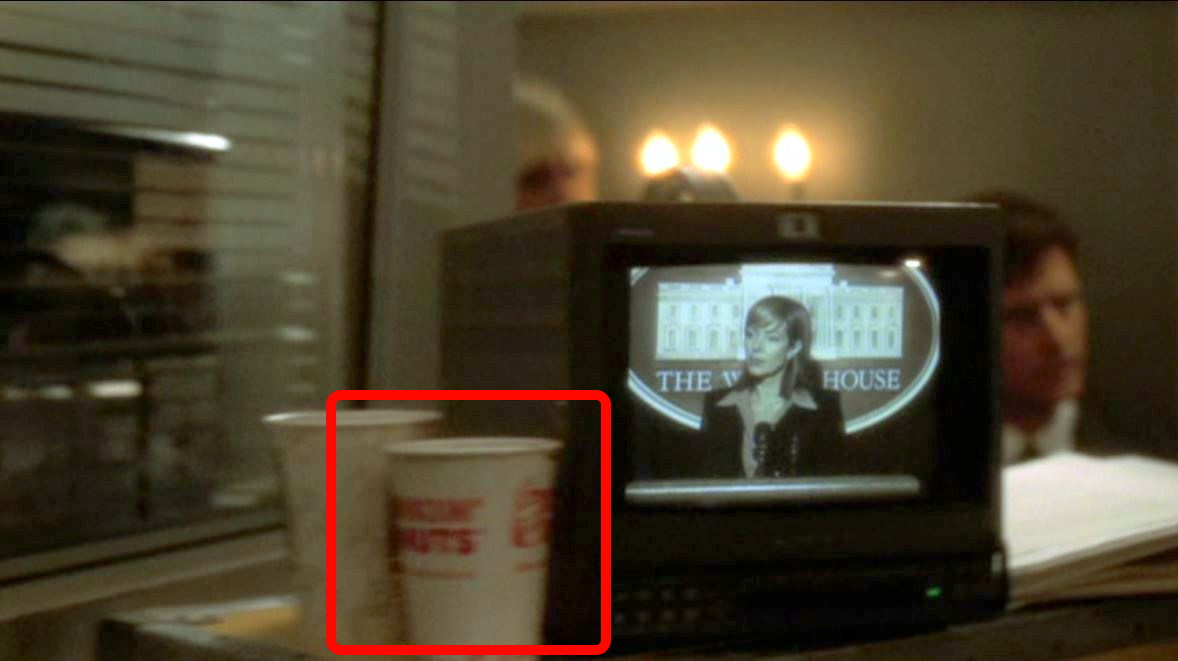
  • A Dunkin Donuts cup is seen in the press room.

  • Toby has a bag of David brand sunflower seeds.

  • There's a bag of Lay's potato chips on Donna's desk.


End credits freeze frame: President Bartlet listening to Lincoln.


Previous episode: Abu el Banat
Next episode: The Benign Prerogative