Sunday, August 6, 2017

The State Dinner - TWW S1E7


Original airdate: November 10, 1999

Written by: Aaron Sorkin (7) and Paul Redford (1)

Directed by: Thomas Schlamme (3)

Synopsis
  • We'll let CJ take this, from the end of the cold open: "So, let me see if I have this. A hurricane's picked up speed and power and is heading for Georgia. Management and labor are coming here to work out a settlement to avoid a crippling strike that'll begin at midnight tonight. And the government's planning a siege on 18 to 40 of its citizens, all the while we host a state dinner for the President of Indonesia."


"You know, one of the things that happens when I stay away too long is that you forget that you don't have the power to fix everything. You have a big brain, and a good heart, and an ego the size of Montana. You do, Jed! You don't have the power to fix everything. But I do like watching you try."


Frustration. Futility. Powerlessness. Boy, oh boy, are these the themes we see hammered at us throughout The State Dinner. Some of the failures are self-inflicted, particularly Toby's. Others, like the hurricane changing course to threaten the carrier battle group, are completely out of human control.

While thinking about this episode, I had to wonder whether this was an attempt by Aaron Sorkin to illustrate thematically what he's said in words throughout the beginnings of this series - that the Bartlet administration is somehow directionless and adrift. In Pilot we hear that the President's unfavorables are up to 48 percent, and his bike accident adds to a list of misfires and missteps making the administration look weak. President Bartlet ends that episode telling the staff, "Break's over." In "Post Hoc, Ergo Propter Hoc" we find out the Ryder Cup team called off their White House visit over Jed's joke, the campaign lost Texas in both the primary and the general (even with a Texan on the ticket!), and the Joint Chiefs are leery of President Bartlet's military leadership. We also hear more about how unfavorable the administration is seen in general. In A Proportional Response we learn a congressman in Bartlet's party blusteringly threatened the President with "not getting out (of his district) alive." In Five Votes Down even more congressional representatives from Bartlet's own party defect from an important gun bill, some hoping to get relatively unimportant yet somewhat humiliating concessions from the White House. In Mr. Willis Of Ohio we see Congress spending the budget surplus on a host of pork barrel projects with no compunctions about being called out by the administration. Sorkin seems to be trying to make it sound as if the Bartlet administration, some eleven months into its term, is a floundering mess.

But Sorkin couldn't help himself and gave the President several wins, as well. The gun bill passed in Five Votes Down, even with Josh and Leo getting into some hot water with their tactics and giving Hoynes most of the credit - yet it was stressed this would be seen as a major victory for the administration. The budget bill passed in Mr. Willis Of Ohio, with the White House managing to convince the Commerce Committee to delay their census-sampling amendment, another big Bartlet win. The retaliatory strike on Syria from A Proportional Response had to give the President a boost in the polls (although that aspect was never mentioned, not even by Mandy). There's plenty of progress so far during this administration, with some major legislative wins - this seems in stark contrast to the weak, directionless White House Sorkin seems to want us to believe in as he sets up his dramatic arc for a turn in Let Bartlet Be Bartlet. Of course, in comparison to our current reality, even a hampered, weakened Bartlet administration is going show more accomplishments than the Trump administration. But let's not kid ourselves -- the William Henry Harrison administration has more accomplishments to show for it than Trump. (Ba dum tiss!)

Anyway - I just think this episode is mostly a chance for Sorkin to show, and not tell, how much frustration President Bartlet is feeling at this point. And he does that with a single day full of sucker punches from fate and Mother Nature, including a hurricane bearing down on the Southeast, a trucking strike looming at midnight with no consensus in sight, anti-government militia holding hostages (including children) in a cabin in Idaho, and a state dinner with the leader of an country whose record on human rights is less than exemplary.

And we get Stockard Channing! Yes, the first appearance of the First Lady, Abbey Bartlet, as she joins Jed for the state dinner with President and Mrs. Siguto of Indonesia.


Now seriously, does this look like a woman who would ever get involved with a Ouija board (as mentioned in The Crackpots And These Women)? Yeah, I don't think so. The wonderful Ms. Channing became a recurring player on The West Wing, getting her picture in the credits starting next season, and winning a Supporting Actress Emmy in Season 3 (she was nominated in this season, in part for this episode). She gets a juicy role here, as a supportive wife (that's her quote up above, enjoying watching Jed try to fix everything), a knowledgeable First Lady (keeping tabs on the trucking strike talks), and comic foil (trying to fix up CJ and a cardiologist, dropping in on Sam and Laurie at the exact right moment).

Let's start with the militia storyline. A group of anti-government types in Idaho were caught in a sting, buying illegal weapons from undercover government agents. When the FBI and local law enforcement moved in, the militia holed up in their cabin with anywhere from 18 to 40 occupants, including women and children. Mandy, anxious to broaden her position as a political consultant and get a foot in the door with making policy, manages to wrangle the job as the communication focal point between the White House and the FBI. When the FBI recommends going in with tear gas to end the siege, Mandy suggests sending in a negotiator first, to show the government's goodwill (and prevent the PR nightmare of pictures of women and children being tear-gassed by the FBI). Josh isn't sure going that against the FBI's recommendation is the smart play, but Mandy takes it personally and thinks that's just sour grapes from her old boyfriend:
Josh: "This isn't abstract, Mandy, this isn't a theoretical problem. The FBI says, 'Come out with your hands up,' you come out with your hands up - at which point you are free to avail yourself of the entire justice system."
Mandy: "Do you really believe that or are you just pissed off because I got in the game?"
Leo (entering): "Mandy, the President's going to go with your plan. Chaffee's going to send in a negotiator."
Mandy: "Good."
Josh: "Well, you're in the game now."  
The militia members end up shooting the negotiator and being taken custody by the FBI anyway - an outcome that brings Mandy up short and makes her physically ill as she realizes the high stakes involved in the big leagues of White House policy making.

On to the trucking strike - not a very important part of the busy day's plot, but it serves as the one area where President Bartlet feels he can do something, anything, to have some sort of effect on the events of the day. The Teamsters' union and the trucking industry are at odds over a two-tier hiring system, which permits newer hires to be considered "temporary" workers and not subject to certain benefit and pay requirements. With the Taft-Hartley cooldown period expiring at midnight, the union can go on strike at 12:01 am unless some kind of agreement is reached.

The President, stymied at every turn by events outside his control (the FBI negotiator's shooting, the hurricane threatening Navy ships, the Indonesian president's rudeness or dullness, he can't tell which), storms into the room where the union and management are having talks and essentially orders some kind of agreement. If that doesn't happen within the hour, he's ready for the government to take over the trucking industry (something President Truman did in 1952 with steel mills, although Jed erroneously refers to "coal miners" in that case) and to call Congress for a special session to give him authority to draft striking truck drivers into the military (also a move Truman attempted with railroad workers in 1946). His determination to do something in the face of other events far out of his control is obvious to his wife:
Abbey: "I'm sorry to interrupt you, actually I was looking for the President."
Sam: "He had to step out to the West Wing."
Abbey: "Oh."
Sam: "I'm not sure why, but I could go --"
Abbey: "To pistol-whip the trucking industry."
Sam: "Uh, why would he --?"
Abbey: "Because he can't save a gunshot victim and he can't stop a hurricane."
Let's move on to Toby's maneuvers with the Indonesian government. He's ready to write the formal dinner toast to President Siguto by himself until Leo directs Sam to join him, because these things are sensitive diplomatic procedures. Toby takes on Sam only to direct him to "toughen up" the language of the toast - Toby, as we have seen, is sort of the moral compass of the Bartlet White House, and he has no time to coddle what he sees as the dictatorial, repressive, human-rights violating Siguto government.
Sam: "Toby -- do you really think it's a good idea to invite people to dinner and then tell them exactly what they're doing wrong with their lives?"
Toby: "Absolutely, otherwise it's just a waste of food."
Meanwhile, Toby and Josh are making plans for an out-of-the-dining-room meeting with one of President Siguto's staffers. This plot is played for laughs - "we gotta see a guy about a thing," the way Josh and Donna lovingly pronounce the name "Rahmadi Sumahidjo Bambang," and of course the entire translation debacle. Donna is tasked with finding a translator from the State Department so Toby and Josh can talk to Mr. Bambang. She locates Mr. Minaldi, a translator who speaks Batak - but then it is later discovered Bambang does not speak Batak, but Javanese, a language Minaldi does not. Admittedly, Donna comes up with a creative, yet workable solution:
Donna: "Well, Mr. Minaldi speaks Portuguese."
Toby: "Where does that get us?"
Donna: "Well, there's a guy who works in the kitchen who can translate Mr. Bombang's ..."
Minaldi: "Bambang."
Donna: "Bambang's Batak into Portuguese. Then Mr. Minaldi will translate it into English."
Toby: "Wait a minute. Uh, why can't the kitchen guy translate Batak into English?"
Donna: "The kitchen guy doesn't speak English."
Toby: "You're kidding me."
Donna: "Well, no, he speaks Batak and Portuguese so I wouldn't look down your nose."
 The humor continues once the meeting begins in the kitchen and the four-way translation gets started ("He's answering a question from like a half an hour ago"), and then - Bambang, out of the blue, says, "Why don't we just speak in English?" which results in this reaction from Toby and Josh:


And then Donna's response of "You should keep in mind all the things I do right."

This is where the plotline isn't so funny anymore. It turns out Toby has a friend, a French professor who helps teach students how to protest, who is being held in an Indonesian jail for leading anti-government demonstrations. Toby wanted to use the occasion of this state visit to ask Bambang for the favor of releasing his friend. Unfortunately, the tough wording in the toast he wrote has backfired on Toby, and Bambang literally tells him he can take his favor and go to hell:
Bambang: "You humiliated my President tonight, and for no other reason but to show off. And now you want me to do you a favor? Go to hell."
Failure and frustration, but totally self-inflicted in this case. Toby's moral high ground, requiring him to chastise the very government he needed to ask a favor of, blows up right in his face.

Just a quick mention of Sam and Laurie before the storm hits - there's some interesting developments in this relationship. The two are having lunch in a diner, where Sam sweetly declares he has no qualms about being seen with Laurie in public, and Laurie tells Sam she has a somewhat regular client that evening who never tells her ahead of time where they are going. So, naturally, it turns out the client is a big Democratic fundraiser, and he's taking Laurie (or "Brittany") to the White House dinner. Sam, of course, is thunderstruck by having Laurie's night call-girl job right there in front of his face, and he thereby not-so-sweetly offers her $10,000 if she doesn't go home with the client at the end of the night. Couple this with Sam taking Laurie's chicken salad sandwich at lunch, and he's really not doing a very good job of "reforming" or "saving" her from her tawdry night job. He's kind of an ass.

Also, reporter Danny Concannon is back. Played by Timothy Busfield (Revenge Of The Nerds, thirtysomething, Field Of Dreams), Danny is going to be another recurring character, and here we discover he's got a thing for CJ. He flirts, asks about her outfit for the dinner, kind of plays a prank on her with the whole vermeil protest thing, and actually asks her out for dinner. CJ, of course, as White House press secretary can do no such thing with a reporter, but you can tell she is intrigued by the idea. The CJ-Danny interplay is going to be a key part of The West Wing for quite a while to come. They do make a cute pair.

And the storm. Yet another of the complications affecting the White House plans for the day, Hurricane Sarah has grown to a Class 4 storm and is taking aim at Georgia and the Carolinas. The Navy winds up sending the Kennedy carrier battle group out to sea from the Norfolk, Virginia, naval base, as big ships are generally better able to ride out a storm at sea some distance from it rather than moored at their docks. The major complication we see by mid-episode is the whereabouts of Charlie's grandparents, who were evacuated from their coastal Georgia home but now can't be located, much to Charlie's dismay. Josh is ready to help ("Donna, call FEMA, use my name. When that doesn't work, use Leo's name.").

Turns out the grandparents in danger is just a Sorkin head-fake. They are located safe and sound, but the hurricane has changed direction and is now heading straight at the carrier fleet in the Atlantic. The ships and crew are in dire danger with 120 mph winds and heavy seas bearing down on them with no escape, and it's one more thing President Bartlet has absolutely no control over. This naturally leads us to one of the most memorable scenes in early West Wing history.


The Navy has set up a phone/radio link to the carrier group, with the intention of having the President speak with the commander. Since the storm has knocked out communications with most of the ships, the only connection they can make is with the repair/maintenance ship USS Hickory - and that ship's captain can't be reached either. So President Bartlet ends up speaking with a young, scared, injured Signalman Third Class Harold Lewis. It's a gripping moment - as Lewis describes the terrible situation the Hickory finds itself in, swamped by heavy seas, its running lights out and in danger of being run over by the aircraft carrier - Jed's face expresses the anguish and concern of a leader who can't do anything to help those under his command.


He tries to crack a joke and keep it light ("I don't know, man. Think I'd ask for my money back"), but his face shows no lightness. His final words come after the screen fades to black:
"Harold? I'm going to stay right here as long as the radio works, okay? (fade to black) Hang on."
Just a couple of other things about that memorable last scene - it begins with the wide shot shown above, then slowly zooms in on the President, the rest of the cast standing and listening, with his face eventually taking up the entire screen. Given the stakes of the moment and the emotionally taut conversation with Signalman Lewis, it's an incredibly well-done shot. You'll just have to forgive the idea of having the President, the First Lady, the Chief of Staff, the Deputy Chief of Staff, the Communications Director and the Deputy Communications Director all leaving the state dinner at once for this. At least CJ must still be doing some work somewhere ...

Notice also in the wide shot above - Josh takes Mandy in his arms. This seems, I don't know, kind of weird. While they were previously lovers, there's really not that kind of connection between them now. Josh did see how upset and sick Mandy was about the FBI negotiator, and I think that's what's behind this gesture, but boy - it sticks out like a sore thumb, kinda.

What's really interesting about this episode is that most of these plotlines aren't really wrapped up by the end of the show. This all takes place in one day, the day of the state dinner - we don't find out if the Teamsters and the trucking industry come to terms (we figure they must, considering Bartlet's threats), we don't find out the fate of the FBI negotiator (he's still in surgery), and we don't find out what happens to the Kennedy battle group in its encounter with Hurricane Sarah. That's a lot more like real life than a typical television episode that wraps everything up at the end of 30 or 60 minutes, and that makes The State Dinner some pretty good TV.


Things to think about:

- We noticed CJ had a Gateway laptop in A Proportional Response. Now we see she's been upgraded to a desktop computer! (It actually can be seen in the background during Mr. Willis Of Ohio, but she gets to use it here). However, it's almost daintily squeezed into the corner of her office, in a rather ladylike design concept. Why wouldn't it be on her, you know, desk?
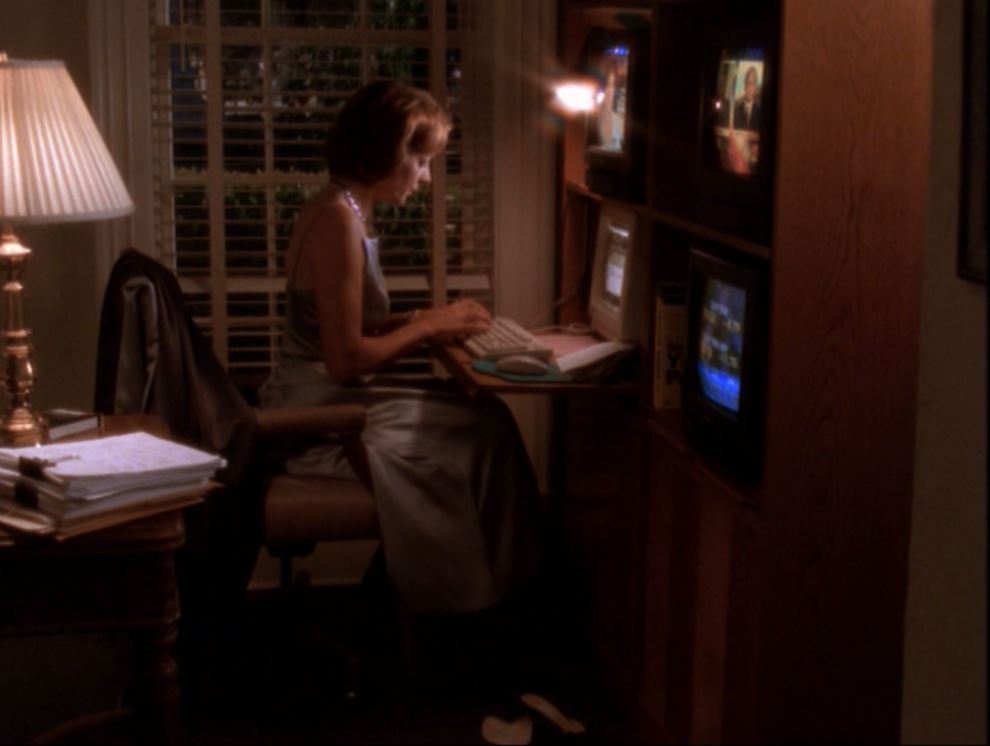

- Speaking of laptops, the White House must have upgraded laptops, as Sam has a Mac. If you'll notice, the late 1990s Macbooks had the Apple logo appear right-side-up when the case was closed, hence upside-down when the laptop was being used. Apple would eventually flip the logo.


Quotes    
CJ: "Mirabella needed to know what wine was being served with the fish course, so, it's a good thing I went to school for 22 years."
Josh: "What wine are we --"
CJ: "It's wine, you'll drink it." 
-----
Bartlet: "We're having salmon tonight."
Siguto: "Yes."
(long pause) 
Bartlet: "They told you that?"
Siguto: "Yes."
(long pause)
 Bartlet: "Yo Yo Ma is going to play. Some Bach concertos, I believe. (long pause) Do you like salmon?"
Siguto: "No."
Bartlet: "Well. Our mistake."
Siguto: "Yes."
----- 
Sam: "Hey, I'm finishing up this speech. Can you think of some sort of personal connection between President Siguto and the US? You know, something from his past?"
Josh: "He was once almost pushed out of an airplane by a CIA-trained operative."
Sam: "I should probably leave that out."
Josh: "Yeah, I would."
----- 

Story threads, callbacks, and familiar faces (Hey, it's that guy!)
  • Even though we don't learn the fate of the USS Hickory in this episode, that is a key part of a dramatic Bartlet speech in Season Two's Two Cathedrals.
  • It's certainly not a direct line from one to the other, but Mandy's handling of the militia standoff and the shooting of the negotiator can't be a good sign for keeping her job. Not to be too harsh, but her basic uselessness to the West Wing staff will continue to grow throughout the rest of the season. Pandas will play a part in her career future. Yes, I said pandas.
  • Laurie's client, Carl Everett, is played by David Rasche, who is a well-known TV actor (Sledge Hammer!).

  • The Teamsters head is played by William Lucking (Sons of Anarchy, Erin Brockovich, The A Team).

  • Meanwhile, the trucking industry honcho is played by John Kapelos (the janitor in The Breakfast Club, also Roxanne, Weird Science).


DC location shots    
  • There are no DC location shots in this episode. In fact, except for the short scene with Sam and Laurie at the diner, the entire episode takes place inside the White House.
References to real people    
  • A bunch of fashion designers are mentioned as CJ talks about the First Lady's outfit: Carmen Marc Valvo, Manolo Blahnik, Gabrielle Sanchez, and Cristina Bomba.
  • President Bartlet mentions the famed cellist Yo Yo Ma will play at the dinner. Yo Yo Ma himself will appear on the show next season. It's also said he will play Bach concertos, so Johann Sebastian Bach must exist in this universe.
  • After Danny leads CJ on the vermeil goose chase, she mentions Jean-Baptiste-Claude Odiot, who worked in vermeil in the 1700-1800s.
  • The aircraft carrier John F. Kennedy is part of the battle group caught in Hurricane Sarah. While that doesn't necessarily mean Kennedy was ever President in The West Wing timeline, we already know Lyndon Johnson was, so JFK most likely was as well.
  • We get a solid mention of President Truman and his 1952 move to nationalize the steel industry (not coal mines, as President Bartlet misstates). Bartlet also threatens to draft striking truck drivers into the army, a move Truman called for during a 1946 railroad strike.

End credits freeze frame: Leo and the President discussing the FBI agent's condition.


Sunday, July 30, 2017

Location Shots & Real People - TWW S1E1-6


As I've developed this blog, and particularly these reviews/revisitings of The West Wing, I keep coming up with additional things I'd like to add. Hopefully this will stop soon - since I'm just 6 episodes in so far, it's not that tough to go back and catch up, but if I think of something new to cover in Season 5 I'm probably screwed.

Anyway, I thought it might be interesting to include the Washington, DC, location scenes that were seen in the episodes, along with references to real people who actually exist in our universe. While The West Wing is, obviously, a fictitious drama created by Aaron Sorkin and other writers, it's meant to be set in something very close to our reality. By including people from real, actual life, we can kind of see where the show splits away from true history. What Presidents actually existed in The West Wing universe, and which ones didn't? What news anchors? What other international leaders? We know (from Mr. Willis Of Ohio) that The West Wing Constitution must differ slightly from our own, otherwise Joe Willis could not have been appointed to replace his late wife in the House of Representatives (Senators, yes, but Representatives have to be replaced in an election). How close do other things hew to our reality?

As for the location shots, I just thought it would be interesting to list which scenes were actually filmed in DC, rather than on the studio lot in California. I heard Sorkin say (I believe it was in the DVD commentary for Pilot, although I'm not 100 percent positive) that the series typically traveled to Washington about four times a year, during which they would film all their location scenes for the pertinent section of that season. Naturally, that would mean the weather wouldn't exactly match up with the timeline (In Excelsis Deo, for example, is the Christmas episode, yet the trees at Arlington National Cemetery are pretty darn green for December). So by pulling out the location shots for each episode, you can almost piece together which trip involved which scene. Nowadays, of course, TV series like Scandal don't need to travel to actual locations at all. Through crafty set-building and the use of CGI and other technical tricks, a movie or TV show can be believably set just about anywhere, without the need of the production to ever actually go film at that location.

(As an actor myself, I also find it intriguing how the actors would have to deal with filming location shots for several different episodes at once, getting into the characters' headspace for differing timelines and varying storylines. For example, I figure all the location scenes for at least "Post Hoc, Ergo Propter Hoc", Five Votes Down, and The Crackpots And These Women were filmed on the same trip east.)


DC location shots (Pilot)    
  • Mandy driving along the National Mall, getting pulled over right on the Mall directly down from the Capitol.

  • Leo and Reverend Caldwell walking along Pennsylvania Avenue in front of the White House.

The scene with Josh and Mandy in the diner was filmed in Los Angeles, not DC (confirmed by Sorkin in his DVD commentary).

DC location shots (Post Hoc, Ergo Propter Hoc) 
  • Mandy ramming her car up on the curb near the Navy Memorial so she can yell at Lloyd Russell. (It appears where she jumped the curb was at 8th Street and D Street NW, if you're interested. That should be the National Archives you see in this shot.)

  • Mandy's BMW getting towed from in front of her "office." This is on Thomas Jefferson Street where it crosses the Chesapeake and Ohio Canal, in Georgetown.

  • The entire scene outside with Sam and Laurie, after he humiliates her in the bar with her client. The door they come out of appears to be The Capital Grille, on the corner of 6th Street NW and Pennsylvania Avenue. (Those are giant cuts of meat on display in the window behind Sam. Also, I believe the same blonde extra you see entering the restaurant here is seen just a moment later across the street hailing a cab.) While the Newseum is now located just east of The Capital Grille, it wasn't built there until 2008, so the building you see there as Sam and Laurie cross the street no longer exists.

  • As Sam and Laurie walk along Pennsylvania Avenue, you can actually see a street sign for the 200 block of 6th Street NW, and the scene ends with them walking past the Andrew Mellon Memorial Fountain, which is across Pennsylvania Avenue from the current Newseum and across Constitution Avenue from the National Gallery of Art (and the Washington Monument is visible in the distance, which if you'll remember had scaffolding around it in 1999 for repairs.)

There are no location scenes in A Proportional Response, although there is B-roll/stock footage of cars driving along Pennsylvania Avenue in front of the White House, which is something you can't do anymore.


DC location shots (Five Votes Down) 
  • Josh threatening Katzenmoyer with the loss of his seat over the vote on the gun control bill, right in front of the Capitol by the Capitol Reflecting Pool. (Can I also add the oddity of both Katzenmoyer and Josh saying the next congressional election is two years away? If this is the fall of 1999, following the Presidential election of Bartlet in 1998, then the midterms are just over one year away. These guys would know that. Later in the episode Representative Wick tells Josh, "I've been here over a year," and that's not true, either ... as a freshman Representative he would have been sworn in early in 1999, so it's been less than a year. Heck, it hasn't even been a year since the election, let alone taking office.)

  • Leo and Rep. Richardson talking in front of the Lincoln Memorial (it's not in this picture, but you can clearly see the scaffolding on the Washington Monument in this scene).

DC location shots (The Crackpots And These Women) 
  • Playing basketball, at night, in front of the White House, on Pennsylvania Avenue, with the President of the United States (and NBA player Juwan Howard). 1999 was certainly a simpler time - even just to film this sequence.

  • Not actually a location shot, but an establishing shot of a building apparently containing the offices of Josh's psychiatrist, Stanley. No idea where this might be located in DC.


There were no location shots in Mr. Willis Of Ohio, although we did see an establishing shot of the Georgetowne Station bar. The location is still a bar in Georgetown, just no longer called Georgetowne Station.


References to real people (Pilot)    
  • Sam refers to Alger Hiss and his pumpkin in the cold-open scene in the bar.
  • Leo is after the New York Times for misspelling "Gaddafi" in the crossword. Muammar Gaddafi was leader of Libya at the time. (Of note: Leo says he's met the man three times and recommended an Exocet missile strike against him. When would he have done that? We find out in A Proportional Response that the Bartlet administration has had no military adventures prior to that. We will also find out Leo served in a previous administration as Secretary of Labor - hardly a position to advocate for missile strikes [with French-made missiles, yet] against a foreign country. As Jed mentions in "Post Hoc, Ergo Propter Hoc", "Now that's a thought that's going to fester.")
  • Castro is mentioned with regard to the Cuban refugees trying to make it to Florida. One must assume they mean Fidel Castro, President of Cuba.
  • Presidents Ulysses S. Grant, Theodore Roosevelt, and Franklin Roosevelt are referred to during Sam's disastrous educational talk to the fourth-graders.
References to real people ("Post Hoc, Ergo Propter Hoc")    
References to real people (A Proportional Response)    
  • Throughout the first several episodes, many national cable news anchors are visible on televisions in the background, including Bernard Shaw, Bill Hemmer, and Christiane Amanpour. Wolf Blitzer is seen with his name actually appearing onscreen.
  • CJ refers to the popular Puerto Rican musical group Menudo while she's trying to throw reporters off the scent of military action.
  • Leo tells President Bartlet he can conquer the world "like Charlemagne" if he wants.
References to real people (Five Votes Down)    
  • Josh wistfully recalls the power LBJ had over Congress, which must refer to President Lyndon Baines Johnson.
  • Leo asks if famed jeweler Harry Winston has sent the necklace for his wife's anniversary. While Winston himself died in 1978, his jewelry company continues to this day.
References to real people (The Crackpots And These Women)    
  • Toby and Josh call out Jed for bringing on tennis superstar Steffi Graf as a ringer during mixed doubles in Florida.
  • Leo's Big Block of Cheese Day got its start, according to Leo, from President Andrew Jackson.
  • Toby makes a convoluted comparison of President Bartlet to Joe McCarthy - just because he plans to speak out against Hollywood movie violence days before appearing at a Hollywood fundraiser. Frankly, I don't see the link.
  • Josh talks about Schubert, the composer of "Ave Maria" - obviously Franz Schubert.
References to real people (Mr. Willis Of Ohio)    
  • Spending money to renovate the birthplace of early feminist Susan B. Anthony is mentioned as part of the appropriations bill.
  • Leo's request to the staff to not do anything to make him look bad causes Josh to compare him to legendary Notre Dame football coach Knute Rockne.
  • The frat boys at the bar throw out some racist comparisons to Charley, including rappers/actors LL Cool J, Ice-T, and Ice Cube. ("Ice Tray," though, I don't believe is an actual rapper or actor. I also love the remark on Ice-T's Wikipedia page warning readers not to confuse him with "iced tea.")


Friday, July 7, 2017

Mr. Willis Of Ohio - TWW S1E6


Original airdate: November 3, 1999

Written by: Aaron Sorkin (6)

Directed by: Christopher Misiano (1)

Synopsis
  • Toby tries to convince three Congressmen, including a recently appointed member from Ohio, to stop a budget bill amendment that would prohibit the use of sampling data in the upcoming census. Meanwhile, Sam explains the ins-and-outs of the census process to CJ. President Bartlet acts fatherly toward both his daughter Zoey (harassed by frat boys at a Georgetown bar) and the-son-he-never-had Charlie. Donna can't understand why she can't have her personal share of a recent budget surplus to buy a DVD player.


"I met an unusual man. He didn't walk into the room with a political agenda, he didn't walk in with his mind made up. He genuinely wanted to do what he thought was best, didn't mind saying the words, 'I don't know'."


One of the things I really love about The West Wing is how it wants to show our government and our leaders not necessarily as they really are, but how we'd hope they'd be - in pursuit of the ideals of a higher calling and the greater good in leading our nation. Mr. Willis Of Ohio (the man and the title) brings to this universe an everyman whose aims are so simple and pure and open that our characters realize they can aspire to even greater heights than they think.

This episode is also a civics lesson. And in typical West Wing fashion, it's a civics lesson cloaked in entertainment and humor. You want to know about the census? This here episode of The West Wing is the one for you. And also the one for CJ, as it turns out:
CJ: "Sam, I read my briefing book last night on the Commerce bill regarding the census, and there's certain parts of it that I don't quite understand."
Sam: "I can help you out, which parts?"
CJ: "Well, all of it."
Sam: "All of it?"
CJ: "Yes."
Sam: "You don't understand the census."
CJ: "I don't understand certain nuances."
Sam: "Like what?"
CJ: "Like, the census."
(While the conceit of having a concept explained to the audience by having it explained to a character on the show is a well-used trope, we'll just ignore the fact that The West Wing often does this through explanations to the female characters, usually Donna. Are we really to believe that a top-notch sharp cookie like CJ doesn't have any idea of what the census is about?)

The other main theme of this episode is the fatherly attitude of Jed Bartlet - not only in his justifiably protective approach towards his youngest daughter Zoey (brought to the fore by three frat bros who harass her in a Georgetown bar), but also towards Charlie. Throughout the series we'll see that Charlie becomes the son Jed never had, and the process of the President taking Charlie under his wing and giving him fatherly guidance develops into an ongoing plotline. Heck, the only reason Zoey was in the Georgetown bar in the first place is because the President told Josh to take Charlie out for a drink (with Zoey and Mallory volunteering themselves to tag along, as well as Sam, CJ, and Mandy EDIT: Not Mandy. Mandy wasn't there, she wasn't invited. Take this as a hint, Mandy).

But to the civics lesson: the House of Representatives is debating a budget bill for the coming fiscal year. While there's a big surplus to deal with ($32 billion), Congressmen are wasting no time finding ways to spend the money. But there's also a pending amendment to the bill prohibiting the use of sampling data in determining census numbers, an amendment the administration is so adamantly opposed to that the President is threatening to veto the entire bill.

So the White House brings in three swing votes from the House Commerce Committee (Representatives Skinner, Gladman and Willis) to try to change some votes. Toby explains that the administration wants to use sampling data to provide a more accurate accounting of all the citizens of the country, including the homeless and those less likely to answer the door-to-door canvassers that typically conduct the census. Supporters of the amendment don't trust data sampling, and want to stick to the traditional "hand count." It comes down to Mr. Willis (of Ohio), who is convinced by Toby's arguments and a reading of a section of the Constitution. Willis agrees to change his mind and vote against the amendment, supporting the administration until such time as the courts make a legal determination on the use of sampling.

(It's stated these three Congressmen are all swing votes, yet Willis is the only one to change his mind. Apparently they only needed one, as we see the administration celebrating victory on the vote at the end of the episode.)

Here's the great thing about Willis. He's just an 8th-grade social studies teacher, thrust into the job to serve out the term of his wife, who died a month prior. He's not a politician, he's not dazzled by the power of the White House, he's not fazed by the career elected officials he's working with - he's just a guy, an everyday American, willing to listen to both sides of the argument and make his decision based on the facts presented. It's a perfect-world version of who should actually be governing, and we know our government is everything but "perfect-world," but it suits our purposes in this episode. What if "just a guy" was thrust into Congress? What if political considerations didn't matter, and every decision was made based on what was best for the country and where the facts led us? Well, it'd be something like Mr. Willis Of Ohio.

And to meet someone as down to earth and as fundamentally honest and open as Joe Willis, well ... that can make even a prickly grump like Toby absolutely beam.


(Of course, here's the thing: Toby's using the Constitution to make his argument on the census. In the very same Article and Section of that document, we would learn that a vacancy in the House of Representatives must be filled by "the people," in a special election; there's no way a governor could appoint the spouse of a deceased Congressperson to fill out the term. Senators, yes, governors do appoint those replacements, but not in the House. Aaron Sorkin admits he knew the facts, but dealing with an appropriations bill - which has to come out of the House - and feeling that the audience would make too many real-world connections with any Senator he might use for this instance, he decided to ignore the actual Constitutional requirements and do it his way. Of course, The West Wing is a fictional universe, after all - perhaps their Constitution is slightly different. Maybe? Fanwank?)

As for Jed and his fatherly intentions showing through, we first really see his concern about his family's safety early on. As a staff poker game in Leo's office is breaking up, the Secret Service holds everyone in the Oval Office because someone jumped the fence. We later find out this person was a mentally disturbed woman with a gun, and she wasn't after the President, but she was after Zoey.

(This information comes to us courtesy of the head of the White House Secret Service detail, Ron Butterfield, played by Michael O'Neill. He'll return in that role many times over the next seven seasons. I think he's just great; matter-of-fact and eminently capable concerning his security role, yet you see the humanity and concern coming through in his acting.)


So, after Jed pushes Josh to take Charlie out for a drink, Mallory (Leo's daughter) and Zoey sweet-talk their way into joining the group. They go to Georgetowne Station, which at the time was evidently a bar in Georgetown near the university.


It's called something different now, but it looks exactly the same and still appears to be a bar in Georgetown (this is a Google Streets image from 2017):


Everyone is having a great time (maybe except for Sam, as he takes a good amount of grief about his ongoing relationship with Laurie, the call girl he's trying to reform), until Zoey is accosted by three frat bros (Georgetown students? It's implied, so much so that the Georgetown student newspaper had to publish a column about the episode). One thing leads to another, Charlie is the first to step up to pull Zoey away from her harassers, and then Josh uses Zoey's panic button to bring the Secret Service to the rescue.

The whole sequence of events - an intruder after Zoey, a kerfluffle in a bar - drives Jed the father crazy with concern, and he has to go to tremendous lengths to convince Zoey of the seriousness of his situation:
President: "My getting killed would be bad enough, but that is not the nightmare scenario. The nightmare scenario, sweetheart, is you getting kidnapped. You go out to a bar or a party in some club and you get up to go to the restroom, somebody comes up from behind and puts their hand across your mouth and whisks you out the back door. You're so petrified you don't even notice the bodies of a few Secret Service agents lying on the ground with bullet holes in their heads. Then you're whisked away in a car. It's a big party with lots of noise and lots of people coming and going, and it's a half hour before someone says, Hey, where's Zoey? Another 15 minutes before the first phone call. It's another hour and half before anyone even thinks to shut down all the airports, and now we're off to the races! You're tied to a chair in a cargo shack somewhere in the middle of Uganda, and I am told that I have 72 hours to get Israel to free 460 terrorist prisoners. So I'm on the phone pleading with Ben Yahbin and he's saying, I'm sorry, Mr. President, Israel simply does not negotiate with terrorists, period. It's the only way we can survive. So now we've got a new problem. Because this country no longer has a Commander-In-Chief, it has a father who's out of his mind because his little girl is in a shack somewhere in Uganda with a gun to her head! Do you get it?" 
It's a great way for us to see the difference between President Josiah Bartlet and Jed the dad, as well as how they are inextricably linked. This is coming up again, at the end of Season 4.

This episode also includes a great running thread with Donna's complaints about not getting her share of the budget surplus returned to her. Sorkin uses this to play with the fiscal stereotypes of Democrats (all the spending listed in the appropriations bill) and Republicans (tax relief, tax relief, tax relief!). Donna actually ends up making a good market-based argument for her side:
Josh: "Let's say your cut of the surplus is $700. I want to take your money, combine it with everybody else's money, and use it to pay down the debt and further endow Social Security. What do you want to do with it?"
Donna: "Buy a DVD player." (CAUTION: auto-play YouTube link, and it's LOUD.)
Josh: "See?"
Donna: "But my $700 is helping employ the people who manufacture and sell DVD players, not to mention the people who manufacture and sell DVDs. It's the natural evolution of the market economy."
Josh: "The problem is, the DVD player you buy might be made in Japan."
Donna: "I'll buy an American one."
Josh: "We don't trust you."
Donna: "Why not?"
Josh: "We're Democrats."
Donna: "I want my money back!"
Josh: "You shouldn't have voted for us."
And finally, Leo tells Jed about the breakup of his marriage with Jenny. Leo has moved out of the house into a hotel (Mallory is actually bringing him some things from home, which is why she's hanging around and able to go out to the bar later - not only to hang around Sam). Bartlet's first reaction to the news is less than gracious:
President: "Fix this, Leo."
Leo: "It's not as simple as that."
President: "It is as simple as that. You're the man. Fix it."
Leo: "Mr. President --"
President: "Fix it."
At the end of the day, and especially after his talk with Zoey, the President realizes his misstep with his old friend, and he offers an apology and a heartfelt response of support for what Leo is going through. Not a huge focus of the episode, but it fleshes out the deep friendship between the two (and the faultlines that any long friendship will have), and strengthens the theme of fatherly/familial support and respect.

So not only a optimistic picture of public service and selfless democracy, but also a picture of overriding fatherly love and affection - that's what we get in Mr. Willis Of Ohio.


Things to think about:

- Sam and Toby are both smoking cigars during the opening poker game in Leo's office. I guess the White House wasn't smoke-free in 1999 (we know the President smokes cigarettes, after all).

- I don't know exactly why, but the rustling suit noises in the episode's first Oval Office scene were incredibly distracting. I don't think I've heard that before, so I don't know if it was a problem with the sound mixing in that scene or what, but once you hear it, you can't stop hearing it.

- I've mentioned the poor taste in background music in previous episodes (even if maybe the producers did have New Order in the broadcast version of "Post Hoc, Ergo Propter Hoc" and just couldn't get the rights for DVD/streaming), but they stepped it up a notch here. In the bar we hear the Foo Fighters' "Learn To Fly" playing in the background. Nice.

- President Bartlet sticks Josh with a crack about going out for "malteds or something" instead of taking his daughter to a bar. Would a New Hampshire guy like Jed call them "malteds"? My research is unclear. Many parts of New England call a flavored ice cream/milk mixture a "frappe" and not a "milkshake," as much of the rest of the country would call them. Rhode Island, of course, calls them "cabinets," which is just weird. However, malted milkshakes might indeed be called "malteds," even in New England, so I don't know if that's a Sorkin mistake or if it's an accurate New Hampshire reference.

- CJ tells Josh "I like beer" when he's asking Sam to come along to the bar with him and Charlie. Once at the bar, though, she's ordering a grasshopper. Not exactly the same as beer ...

- Charlie tells the frat bros they'd need to take Zoey to Maryland to buy her a drink, as she's 19. I don't know what he means by that; all 50 states raised their drinking age to 21 by the late 1980s in order to prevent a loss of federal highway funds. You suppose he was just taking a dig at Maryland somehow?

- The epithets hurled at Charlie (and later Sam and Josh) by the frat boys in the bar aren't all that creative or groundbreaking. Kind of an obvious racial slant to things like "LL Cool J," "Ice T," Ice Cube," "G-Funk" or "Dr. Huffy Puffy Dread, man." Seriously, Huffy Puffy Dread? Then they up the ante with "Dr. Doolittle" and "Dr. Faggot." Wow, real deep thinkers, these college boys. But then the "Fairy Poppins" thrown at Sam, well, that's got Sorkin all over it.

- Toby is watching the House vote on the budget bill on C-SPAN while the poker game gets set up. Leo tells him he doesn't need to watch, they won "40 votes ago," but Toby wants to witness Joe Willis casting this vote. But take a look:


That appears to show the "2001 Appropriations Bill" currently losing 74-22, with less than 5 minutes remaining on the roll call. Now sure, congressional vote-counting is a thing where you often can count your chickens before they're actually recorded votes, but to say "we won it 40 votes ago" when there's still almost 340 votes to be cast? Hmm ...

- Product placement: at the bar the guys are drinking Heineken and Michelob. Zoey (underage, remember) appears to have a Diet Coke. Leo is drinking Canada Dry ginger ale during the first card game (although interestingly, everyone starts out with bottled water as they sit down for the game at the end of the episode).

Quotes    
Toby: "Kathy, I need a copy of Article 1, Section 2."
Kathy: "Article 1, Section 2 of what?"
Toby: "The Constitution."
Kathy: "Is that something I'm supposed to have at my desk?"
Toby: "Does anyone have a copy of the Constitution?"
(blank looks from everyone)
Toby: "This is discouraging."
Kathy: "Bonnie, would you get Toby a copy of the Constitution?"
Bonnie: "Is it still in print?"
Toby: "Aw, for crying out loud! Try Amazon dot com, if they don't have it, then just bust into the glass display case at the National Archives!" 
----- 
Donna (to Josh, about the surplus, multiple times): "I want my money back."
----- 
Sam (when the topic of his call girl friend comes up at the bar): "Mallory -- does your father know?"
Mallory: "No."
Sam: "Zoey. Does your father know?"
Zoey: "Not yet."
Sam: "Oh, so this is going to be a thing."
-----
Charlie (after Josh and Sam are discussing which two frat boys they would have fought at the bar): "There were no two guys that either of you could have taken."
(Which results in this reaction from Josh and Sam:)

-----
President: "What were you doing, taking my daughter out to a bar?"
Josh: "You -- told me to, sir."
President: "I told you to take Charlie. When Zoey said she was going I just assumed you were going to go have malteds or something."
Josh: "Malteds, sir?"
President: "Yes."
Josh: "What is this, 'Our Town'?"
 (I love the face Jed gives Josh after that snarky line.)


(a few minutes later)
President: "You know, I once played the Stage Manager in a production of 'Our Town'."


Story threads, callbacks, and familiar faces (Hey, it's that guy!)
  • Congressman Gladman is played by Kenneth Tigar, a pretty recognizable character actor. You might recall him as the German guy who stands up to Loki in The Avengers.
  • Congressman Skinner is played by Charley Lang, another character actor who had recurring roles in the TV series Dark Skies, Seven Days, and Murphy Brown. His Congressman character actually appears a few more times in The West Wing.

  • The main frat boy facing off with Charlie and Sam was played by Eric Balfour, who had recurring roles in the series 24, The OC, and Six Feet Under.

  • As alluded to above, the "nightmare scenario" outlined in Jed's speech to Zoey plays out in an eerily similar way in the Season 4 episode Commencement, including Bartlet's realization that his situation as a helpless father makes his position as a nation's President untenable. Thanks a lot, Jean-Paul, you jerk.
  • Zoey is specifically referred to as being 19, not once but twice. This makes great sense with her starting at Georgetown in the coming January. Listen closely in upcoming episodes, though - that age might mysteriously change.
  • Nancy (Renee Estevez) is back, delivering a line in the Oval. Good old Nancy.

End credits freeze frame: Josh giving sass to the President and Leo.


Tuesday, June 27, 2017

The Crackpots And These Women - TWW S1E5


Original airdate: October 20, 1999

Written by: Aaron Sorkin (5)

Directed by: Anthony Drazan (1)

Synopsis (from Wikipedia, with some additions)
  • The staff members participate in Leo's "Big Block of Cheese" Day, when they meet with fringe special-interest groups who normally cannot get attention from the White House. Toby and the President clash on several issues, from cheating at basketball to the recent gun bill to domestic policy. Josh receives a card from the National Security Council and later learns he is the only senior staff member (other than Leo) who will receive protection or security in the event of a nuclear attack. The President's daughter Zoey arrives at the White House, so the President holds a celebratory chili supper for the members of the inner circle. 


A tale of two episode-ettes:
"I couldn't live without you, Toby. I mean it. I'd be in the tall grass. I'd be in the weeds."
-----
President: "We were talking about these women."
Josh: "Yeah?"
Leo: "We can't get over these women."
-----

This is one of the more polarizing early episodes for fans of The West Wing. For the most part, it's a tightly wound episode with lots of meaty backstory for our characters. It provides some important background into the relationship between President Bartlet and Toby, who feud throughout the episode over greatness versus practicality. We also have insight into Josh's personal history and serious survivor's guilt, something that pays off with great depth in his story for next season. And of course, it's the first "Big Block of Cheese" Day, a fan favorite as Leo brings in special-interest groups to plead their cases to the staff. That's the "Crackpots" part of the title.

On the other hand, the "These Women" share of the episode lands with kind of a thud. I don't recall having much of a reaction to this during the original run back in 1999, but when I re-watched the episode on my first go-round a couple of years ago, much of that final scene was pretty awful, in retrospect. Aaron Sorkin took a lot of grief (deserved or not) over his writing for women, and his treatment of female characters, and this last bit of this episode almost seems like his over-the-top apology to those critics. It's just so ... hamfisted. It rings hollow and it sounds silly coming from these characters.

So let's delve into this to start with. Throughout the first episodes of the season, the senior staff has been shown to be almost entirely male (with the exception of CJ, of course - and Mandy, who I almost forgot, not without good reason). Meanwhile, almost all the support staff is female (Donna, Margaret, Mrs. Landingham, Carol, Kathy), carrying out the stereotypical secretarial duties while the men do the important stuff. This in and of itself isn't wrong, or inaccurate - but in a fictional universe that wants us to be better than we are in reality, it might be nice to steer things away from stereotype. Indeed, later we're going to see characters like the Surgeon General and President Bartlet's national security adviser being played by women, not to mention a strong Emmy-winning character in Stockard Channing's First Lady, while the roles CJ and Donna play get fleshed out and grow more important.

But Sorkin's reaction here in episode 5 is to basically have a scene where the President, Leo, and Josh gawk at the women and remark about how great they are. I mean, this is cringeworthy, in a lot of ways:


Leo: "We can't get over these women."
President: "Look at CJ. She's like a fifties movie star, so capable, so loving and energetic."
Leo: "Look at Mandy over there. Going punch for punch with Toby in a world that tells her to sit down and shut up. Mandy's already won her battle with the President, the game's over. But she's not done. She wants Toby."
President: "Mrs. Landingham. Did you guys know she lost two sons in Vietnam? What would make her want to serve her country is beyond me, but in 14 years she's not missed a day's work, not one. There's Kathy, Donna, Margaret ..."
It just seems to me Sorkin could have found a lot of better, more artful ways to answer his critics. In fact, just the very topic of a female in a position of some power not having everything she needs to do her job is addressed quite well in Lord John Marbury later this season.

So, yeah. That bit hasn't aged well, and it does cause some differing opinions among The West Wing fans. Because a lot of people really look at this episode as one of their favorites, usually because of the "Big Block of Cheese" thing.

This is Leo's pet project. He wants to open up some White House staff time to talk to groups who may have a narrow interest, or would like the government to hear about a certain topic that doesn't generally get a lot of attention. The cheese part comes in because of Andrew Jackson, who had a huge block of cheese in the White House at one point during his Presidency, and would open up the doors to let the public in to help themselves to the cheese.

(Leo has some inaccuracies about the story. There's no evidence Jackson took advice or comments from the public as they chowed down on the cheese; the actual block was about 1400 pounds, not "over two tons;" and Thomas Jefferson actually was gifted a huge block of cheese well before Jackson's presidency).

We learn that Leo intends to have this happen the first of every month, yet it's only actually occurred twice in "twelve months" according to Toby (interesting, since the Bartlet administration only took office about nine months ago). Since Mandy is the new addition to the staff, let's hear how it's explained to her:
Toby: "It's throw-open-our-office-doors-to-people-who-want-to-discuss-things-that-we-could-care-less-about day."
Mandy: "Well, that sounds goofy, doesn't it."
Sam: "It's not so bad. You talk to them for a minute, you give them a souvenir pen with the Presidential seal on it ..."
Mandy: "Isn't this a waste of time?"
Margaret: "Oh, it's definitely a waste of time, but it's one of Leo's pet office policies."
So, the two Big Block stories we get here are CJ learning about Pluie the wolf, and Sam finding out about a possible UFO from a fellow from the United States Space Command. The story about Pluie has a basis in fact, as a wolf whose travels around the Rocky Mountains were tracked and studied by scientists. Here, though, a group is trying to convince CJ to have the government commit $900 million to build a "wolf highway" between Yellowstone National Park and the Yukon Territory, to help wolves travel in safety instead of encountering dangerous roadways, towns, and people.

Oh, and one of the people talking about Pluie is played by Nick Offerman, who you probably recognize as Ron Swanson in Parks and Recreation.


Sam gets Bob Engler from Space Command, who says the White House needs to pay more attention to UFOs, and mentions a mysterious object being tracked in space over the Pacific Ocean at this very moment. Here we get a first look at Sam's office, by the way: He has quite a collection of baseball caps (including one from the Department of Justice), a Muhammad Ali poster, a Los Angeles Lakers jersey (since Sam is from California), and a Naval Jack.


Also, if you remember Sam's comment to Mandy about handing out pens, just look at what's on his desk when he's coming in to talk to Engler.


All ready to hand out. Little details like this just make me love this show even more.

Let's not forget the debut of Bartlet's daughter Zoey, played by Elisabeth Moss (Mad Men, The Handmaid's Tale). She's coming down from Hanover, New Hampshire, to look for housing before she starts at Georgetown for the spring semester in January. In honor of her visit, the President excitedly spouts, "I'm gonna make chili!"
President: "Hey, listen up, everybody. Zoey's down from Hanover, I'm making chili for everyone tonight."
Staffers: (murmuring) "Great. Chili. Okay."
President: "All right. You know what, let's do this. Everybody look down at the big seal in the middle of my carpet. Now, everybody look back up at me. Zoey's coming down from Hanover and I'm making chili for everyone tonight."
Staffers: (energetically) "That's great! I love chili! Terrific!"
President: "There, you see how benevolent I can be when everybody just does what I tell them to do? Now, sit down."
This is the first mention of Zoey; in Pilot President Bartlet talks about a 12-year-old granddaughter he has by one daughter, but Zoey is obviously not that daughter (we will find out later that the Bartlets have three daughters in all). Zoey is a key part of The West Wing throughout the Sorkin years and into Season 5, but she kind of drifts away after that. A big part of her story is a developing romantic relationship with Charlie - here they've just met in the kitchen, and are tampering with Jed's chili recipe together.


Let's move on to Josh. He gets a visit from a fellow from the National Security Council, who gives him a card with directions to follow in the event of a nuclear attack. Obviously, in order to keep the government running, top officials would be swept away in Air Force 1 or taken to a bunker in the event of war. We get to see Josh's incredibly overstuffed wallet as he sticks the card in there. He's got to have serious back issues with that thing in his back pocket.


Josh unfortunately first takes this news to mean everybody in the West Wing has such a card, including Donna and other staffers. He quickly figures out that's not the case, but it takes him longer to realize he's the only senior staffer (except for Leo) who's on this list - not Toby, not CJ, not Sam.

That has a serious affect on him, so much so that he returns to his psychiatrist "Stanley" (who he has seen before, but he hasn't been there for 10 months, which would have been prior to the inauguration). And now we discover that as a young boy, he escaped a fire that killed his older sister, who was babysitting him at the time. It's quickly obvious Josh is suffering from survivor's guilt, and much of his life and drive is based on making amends for what he feels like was having a hand in the death of his sister. As I mentioned above, this background for Josh is going to play out with great impact in Season 2, and Bradley Whitford will earn an Emmy for it.

Too bad his wallet couldn't win an Emmy, too.


At the end of the episode, Josh decides to turn in his card (I don't know if that would even be allowed, but whatever). He gives a stirring speech to the President and Leo, with high-minded selflessness (not to mention that healthy dose of guilt, which showed through in his earlier conversations about the card with Sam and CJ):
"I want to be a comfort to my friends in tragedy, and I want to be able to celebrate with them in triumph, and for all the times in between I just want to be able to look them in the eye."
Then, of course, to fit into the theme of the episode, he nearly ruins it all:
"I want to be with my friends, my family, and these women." 
These women. Again.


Finally, the biggest plotline, Toby and the President. It starts right with the cold open, as Jed and his staffers are playing a little pick-up basketball game (right on Pennsylvania Avenue! Oh, those pre 9/11 days). Toby can't resist poking at the President with some trash talk - of course, trash talk in The West Wing has a certain panache ...
"After you're gone, and the poets write 'The Legend of Josiah Bartlet,' let them write you as a tragic figure, sir. Let the poets write that he had the tools for greatness, but the voices of his better angels were shouted down by his obsessive need to win."


The President responds here by bringing out a former Duke basketball star, Rodney Grant (played by NBA player Juwan Howard, who was with the Washington Wizards at the time, so he was nearby), who joins the President's team for game point against the squad of Toby, Josh and Charlie. (We also learn the President cheated at mixed doubles tennis against Toby and CJ by playing with Steffi Graf). Rodney immediately rejects Toby's shot ...


...prompting Bartlet's great comeback to Toby:
"Let the poets write about that there, Byron."
You also have to love the moment where Toby is chewing out Bartlet about bringing in a ringer, and the President is actually hiding behind the tall basketball star.


That's so cute! And the game serves as a lighthearted introduction to some conflict between Toby and the President, but boy, does it grow throughout the episode. Toby's remark about the President's "better angels" being "shouted down" by practical expediency comes up again and again, from the President wishing to avoid talking about the weaknesses of the gun control bill passed in Five Votes Down, to the decision to attend a Hollywood fundraiser hosted by a maker of gratuitously violent and sexual films. Toby serves as a gadfly to the President here, almost as if he's the little conscience sitting on Bartlet's shoulder trying to talk him into doing the right thing for the right reasons.

Of course this doesn't sit well with the President, and he spends a lot of the episode being irritated at Toby. At a practice for an upcoming press conference, we get this:
President: "Ah, Mr. Ziegler, from the Coney Island Killjoy, you have a followup?"
Toby: "You're gonna take that question. You're lucky enough to get the question, you're gonna blow it off?"
President: "Yes."
Toby: "Due respect, sir, may I ask why?"
President: (sarcastically) "Cause I'm weak-willed and stupid."
And just a bit later, in the back area of the press room:
CJ: "Good morning, Mrs. Landingham. Where are we in the saga of Toby and the President?"
Mrs. Landingham: "They seem to be having a, disagreement."
CJ: "A disagreement or an argument?"
Mrs. Landingham: "Well, it certainly has the potential -"
President: (shouting from the press room floor) "Oh, for God's sakes, Toby!" 
Mrs. Landingham: "There we go."
To add insult to injury, Mandy later lets Toby know that he wasn't the first choice for White House Communications Director, that David Rosen had turned the job down first. She means it as a compliment (she's saying Toby is far better than Rosen ever would have been), but Toby never knew he wasn't Bartlet's first pick. Considering the recent conflicts between him and the President, this adds another layer of grievance for Toby.

But we do get a great scene between the two at the end of the episode, calling back to Toby's trash talk at the start and proving that regardless of who was the first choice, Toby was the right choice.
President: "I couldn't live without you, Toby. I mean it. I'd be in the tall grass. I'd be in the weeds. I know I disappoint you sometimes. I mean I can sense your disappointment. And I only get mad because I know you're right a lot of the times. But you are not the kid in the class with his hand up, and whatever it was you said to CJ. You are a wise and brilliant man, Toby. The other night, when we were playing basketball, did you mean what you said? My demons were shouting down the better angels in my brain?"
Toby: "Yes, sir, I did."
President: "You think that's what's keeping me from greatness?"
Toby: "Yes."
President: "I suppose you're right."
Toby: "Tell you what, though, sir, in a battle between a President's demons and his better angels, for the first time in a long while I think we just might have ourselves a fair fight."
Toby as the moral center of The West Wing universe is one of the overriding themes of the entire series, and it really takes hold here. It's going to help win him an Emmy for In Excelsis Deo later this season, it's going to come through (intermittently, to be honest) with <SPOILER ALERT> fatherhood, and it justifies and enlightens his overall prickly personality. There's quite a turn with what goes on with Toby in the post-Sorkin years (a character move that I understand didn't go over well with Richard Schiff), but you can almost paint his actions in the last two seasons as being aligned with this sense of morality and doing what's right, regardless of the consequences. We'll talk about that down the road.

So much to like in this episode. That ending, though ... doesn't age well.

Things to think about:

- We've got the iconic, stirring, orchestral version of the theme song! Finally! Composer W.G. "Snuffy" Walden actually talks about this in an episode of The West Wing Weekly podcast. As I've mentioned, the theme didn't appear in Pilot, because they hadn't settled on one yet. Once Walden came up with the theme, he didn't have time to get it fully orchestrated and recorded, so for episodes 2-4 it was a version he basically played himself electronically. But by now, it's all done and fully fleshed out. I've got it for my ringtone, by the way.

- There's a couple of mentions of press coverage of the First Lady and her Ouija board. Once we meet Stockard Channing as Abbey Bartlet in The State Dinner, you'd have a hard time believing she ever used a Ouija board - of course this is a callback to Nancy Reagan and her astrologer.

- While practicing for the press conference, when the President answers a question from Sam he refers to "Helen," as one of the White House reporters. This would be a shoutout to longtime White House correspondent Helen Thomas, who reported from the press room for nearly 40 years and often traditionally got to deliver the first question during briefings.

- I mentioned Josh's big wallet. How about his big coat? We first saw it when he went to hire Mandy in "Post Hoc, Ergo Propter Hoc" ... nothing really says late 1990s like an oversized men's coat.


- While West Wing fans usually think of Leo's Big Block of Cheese day being an annual thing, it's clearly stated that the goal is to do it on the first of every month (and they've only done it twice so far, about nine months into Bartlet's term). So this episode should be around the first of the month, right? On Sam's desk, his calendar/planner is open to the 16th.

- Product placement this week: Sam is reading USA Today (the President is later reading the Washington Post, but that's almost a given); Toby has a cup from Roasters On The Hill coffeeshop (which doesn't apparently exist anymore, although the Library of Congress has a photo of customers at that shop in 1990); President Bartlet is drinking a can of Barq's Root Beer when he hears Zoey is coming to visit.

Quotes    
Mandy: "Yes, and Mr. President, if you could further see clear to not answer that question like an economics professor with a big ol' stick up his butt, that would be good, too."
President: "I am an economics professor with a big old stick up my butt, but I'll do my best for you there, Mandy." 

Story threads, callbacks, and familiar faces (Hey, it's that guy!)
  • There's Ginger! She's seen in the background a couple of times, including (of course) the "These Women" scene. She still hasn't had any lines, and her only credit is as "Kim," but it's good to see she's working.
  • And there's Carol, this time actually working for CJ! She's been just doing odd jobs around the West Wing, I guess, but from now on she'll be CJ's assistant.
  • Part of Josh's emotional issues are played out by his having "Ave Maria" stuck in his head, which he also plays while talking to CJ about the NSC card and then plays over the final scene at the chili party. He says it was his sister's favorite music. This connection to his childhood guilt and overall psychology will be referred to again.
  • One of the conflicts between Toby and Mandy is about an upcoming trip to California "in a few weeks" and a pending fundraiser held by moviemaker Larry Posner. We do see a Presidential trip to California with a fundraiser that causes some conflicts, but it's not with Posner - that's in 11 episodes (20 Hours In L.A.) and therefore must not be the same trip we're talking about here.
  • Toby learns that Bartlet first offered the Communications Director job to David Rosen, who turned it down to work for Salomon Brothers. "David Rosen" is also the character name of the Attorney General in Scandal, played by Joshua Malina (who will join the cast of The West Wing in Season 4).
  • The President says Zoey is scouting off-campus housing before she starts at Georgetown in January. Later on this season we're going to see Zoey living in something that looks a lot like a dorm (with her Secret Service protection staying right across the hall). Also, Jed mentions Zoey's next four years in college ... she actually graduates at the end of Season 4 (Commencement - no spoiler alert with that episode title), so in truth, she spends 3 1/2 years at Georgetown.
  • Rodney Grant, the basketball player, is revealed as having played at Duke ("He was in two Final Fours!" Toby exclaims, and a "two-time ACC Player of the Week" according to Sam). Interestingly enough, we will later discover Sam is a graduate of Duke Law School. As is my son, but that's neither here nor there. :)
  • In his chili party speech about Zoey, President Bartlet says a couple of telling things.
"I hope that by the time we're done with our four years here, we'll have seen to it that every young person who chooses can go to college and beyond regardless of their economic status."
First of all, making college more affordable becomes a key policy point for the Bartlet administration. It's really developed during 20 Hours In America in Season 4, and is an underlying Bartlet policy during his term (although I believe in one of the later seasons, they actually give back part of their progress on college costs in negotiations with Republicans).
Secondly, "our four years here"? Isn't President Bartlet planning on running for re-election? His staff certainly is, as seen in the comments about Lloyd Russell's plans in Pilot. Perhaps Jed knows more about his future than his staff or we, the audience, do at this point. Is Sorkin starting to plant some health-related seeds here? Stay tuned.

End credits freeze frame - CJ listening to the tale of Pluie.