Thursday, January 11, 2024

Things Fall Apart - TWW S6E21


Original airdate: March 30, 2005

Written by: Peter Noah (5) 

Directed by: Nelson McCormick (1)

Synopsis
  • The competing Democratic campaigns work feverishly to strike a deal and settle on a Presidential nominee to avoid chaos at the upcoming national convention. Charlie is caught sneaking around Zoey's room - by the President. And an oxygen leak on the International Space Station leads to a national security leak from the White House.


"Now that's the civilian shuttle."
"Sorry?"


Once again - and it should come as no surprise - as we hurtle toward the end of another West Wing season, we find ourselves swept along in a building torrent of events, leading us to what looks like another season-ending cliffhanger. We not only see the chaos of a brokered Democratic National Convention on the way, and the furrowed brow of President Father Bartlet considering Charlie's intentions towards his daughter, but the very serious likelihood of a national security leak coming out of the White House, from one of our very West Wing denizens.
 
There's a lot to take in here! First off, we have the continuation of what we saw in In God We Trust, a divided Democratic Party unable to settle on a candidate for President before the national convention. Both Vice President Russell and Congressman Santos are close to clinching the required number of delegates, but they aren't quite there yet - and former Vice President Hoynes is lurking as a kingmaker, or perhaps an option the party could "turn its lonely eyes to" if the convention stays deadlocked for too long. Attempting to avoid a chaotic, disorganized convention (especially as a reflection of the smoothly organized Republican convention we see going on during this episode), the top leaders of the Democratic Party - namely, President Bartlet and Leo - are anxious to clear up the uncertainty and get a candidate in place before the convention starts.
 
Russell wants to do that too. As the frontrunner, he feels he's holding all the cards, and he sends out a feeler to Pennsylvania Governor Eric Baker about his willingness to join the ticket as the VP. Baker, you remember, was the leading candidate for the Democrats before the primaries began, but dropped out due to personal family reasons, leaving the race wide open.
 

Baker is receptive, but it turns out he's the backup plan. Russell and his team think the first choice would be for Matt Santos, the neck-and-neck second place candidate, to come on the ticket. Once Will floats the offer to Josh, Josh takes it to Matt, interrupting a little "personal time" in the bargain.


(I have to say, the show's continued portrayal of the Santos couple as a young, vibrant, loving couple who really dig each other is pretty neat. I like that they still canoodle and enjoy each other's company!)

This is a tough offer to turn down, especially as Helen stands firm with her opinion that Russell can't win, would be a bad President anyway, and if the primaries had gone on for another week, Matt would have clinched the nomination. Remember, this campaign was a long shot from the beginning, back when Josh traveled down to Houston in Impact Winter to see if Matt was interested, and back in New Hampshire in Opposition Research when Matt figured he was just in this for a few weeks to get the topic of education on the table. But now things are "getting real," as they say.

Matt: "Hard to say no to the vice presidency."

Josh: "Well, it's not what you signed up for."

Matt: "No one signs up to come in second."

Josh: "Are you kidding me?"

Matt: "We didn't."

Then the White House itself comes down on all three candidates - stop the bickering over the convention, about who has the better hotels or which delegations will be up front, and act unified. Leo also has a message for Josh; get Matt to agree to take Russell's offer.

Interestingly, when Josh and Donna cross paths in a hotel bar, the discussion goes to Russell's offer, and it turns out Donna has a different take from her boss:

Donna: "You want him to accept?"

Josh: "You don't."

(pause)

Donna: "I have concerns."

(pause; then rapidly)

Josh: "He's not hit-man enough."

Donna: "Too much voltage at the bottom of the ticket."

Josh: "Overshadows the nominee."

Donna: "Gets people wishing the names were reversed."

Josh: "People willing to wait til next time. (they smile at each other) How'd you get so smart about this?"

Donna: "I had a good teacher."

But the meeting is set up, Matt and Russell retire to speak alone in Russell's suite (where Matt also offers to flip a coin to see which man would get to run as the Presidential candidate, a halfway-serious quip Russell does not find humorous) ... until the meeting quickly breaks up with Matt striding out of the room and into the elevator.

Matt: "Mad at me?"

Josh: "No. (pause) Oddly."

Matt: "Disappointed?"

Josh: "Proud, I think."

Josh has to face Leo again, telling him Matt turned down the offer, which gets Leo more than a bit peeved - but there's nothing he can do about it. 

Leo: "Matthew Santos has had a terrific ride. Improbable, impressive - and over. This is a return to reality. He's Russell's Vice President."

Josh: "It's not gonna happen."

Leo: "You are going to do this for the President. For your party."

Josh: "I'm not. I don't agree with it. I told him to say yes - I was wrong. He's twice the man Russell is on his best day. Ten times. And Russell doesn't have that many best days."

Leo: "I'll go tell the President."

The Democrats are going to the national convention without a Presidential candidate, and it's probably going to be a mess. 

The lighter plot thread of the episode consists of Charlie, back to seeing Zoey (and sleeping with her, right there in the White House!), and Zoey's dad President Bartlet catching him pretty much red-handed in the residence. We first see Charlie getting a secret message from someone (it's Zoey) on his phone, then later that night in Zoey's doorway:


After Charlie says his goodnights, he happily heads down the hall - until he hears a sound from behind:


As a father, Jed is less then enthused about his daughter having relations practically under his nose (even though Zoey is a college graduate and turned 25 in In The Room).

President: "I think perhaps the best thing is for us to carry on as if this encounter hadn't happened."

Charlie: "Due respect - I'm having a hard time exactly imagining that."

President: "It's one in the morning, we both have to be at work in a few hours, and you're standing outside my daughter's bedroom. I say we give it a shot."

When Jed brings this up with Abbey later, it turns out she's known for a while - they kept it a secret from Jed because, well ... dads, you know? The President calls Charlie in to the Oval Office for a meeting about it, where Charlie ends up making his case for having a more open relationship with Zoey instead of sneaking around, which Jed misinterprets as Charlie getting ready to propose, which leads to ... some confusion about the issue, which doesn't really get cleared up. More to come, maybe.

Meanwhile, in the storyline that's going to play out all the way through Season 7, there are life-and-death consequences in orbit above the earth. There's an oxygen leak on the International Space Station, and if the astronauts can't stop it they will suffocate in three weeks. The NASA administrator comes by to talk with the President, but when Bartlet's not available he meets with Kate and CJ instead - where his slip of the tongue proves consequential.

CJ: "Can't a shuttle be pressed into service notwithstanding the review?"

Administrator: "One's missing half its wing assembly, the other's undergoing tile replacement. Now, we can try and speed up repairs ..."

Kate: "The concern would be losing the shuttle crew and the station crew."

Administrator: "Now, that's the civilian shuttle ..."

CJ: "Sorry?"

There's another shuttle, a non-civilian military shuttle, that no one without top security clearance knows about? Well, now CJ knows, or at least uses the administrator's slip to figure out, along with reviewing Pentagon space-related budgets and a chat with Toby.

Remember, Toby's brother David was an astronaut in the space shuttle program; back in What Kind Of Day Has It Been Toby and everyone else was on edge waiting to see if David and his crew were able to return from orbit safely when that shuttle had some reentry problems. Toby is already dealing with an emotionally fraught situation with his brother, who took his own life after being diagnosed with cancer (Drought Conditions), so he's a bit taken aback when CJ brings him up. She wants to know if David ever mentioned the existence of a military shuttle, or even hinted at such a thing.

Toby admits that, yeah, occasionally his brother might hint at lording some secret like that over him - one more bit of information for CJ to confirm her suspicions. Eventually she's officially brought into the loop with the President, Kate, and Secretary Hutchinson, but what seems to her a no-brainer (just launch the thing and go save three lives) isn't such a quick decision for the President. Not only would using the military shuttle on a rescue mission expose its existence, but one of the men on the ISS is a Russian cosmonaut, who would undoubtedly gather as much intelligence about the ship as he possibly could.

We get a lot of shots of CJ brooding in this episode, brooding over the fate of the astronauts, sitting alone looking at the TV as the decision to save them or not isn't being made, staring at the news as those ISS crewmen are slowly being suffocated. Finally, we get a dramatic revelation - Annabeth bursts into Toby's office with word of Greg Brock's upcoming New York Times story exposing the military shuttle program, making the whole secret enterprise open to the world. And apparently someone with knowledge of the shuttle, connected to the White House, has confirmed the information with Brock, giving him the certainty to publish ...

A scene which is immediately followed by another shot of CJ, sitting alone in the dark, musing over ... something. What are Peter Noah and Nelson McCormick trying to tell us? There's one more episode of the season to come - will we get answers, or is it cliffhanger time again?


Tales Of Interest!

- Previous season-ending cliffhangers included the shooting at Rosslyn at the end of Season 1 (What Kind Of Day Has It Been); the unanswered question to President Bartlet about his intentions to run again (although we realize what his answer is going to be, it's not quite a cliffhanger) at the end of Season 2 (Two Cathedrals); what the fallout will be for President Bartlet ordering the assassination of Sharif at the end of Season 3 (Posse Comitatus); Zoey's kidnapping and Jed's stepping away from the Presidency at the end of Season 4 (Twenty Five); and the invitations to the Camp David Mideast summit and Donna's recovery from surgery at the end of Season 5 (Memorial Day). We are not quite to season-ending cliffhanger territory yet, but the setup is here.
 
- Leo's whiteboard, first seen in 365 Days, serves as a countdown of the final year of President Bartlet's administration, leading us to January 20, 2007. The 178 we see here makes this July 26, 2006 - which fits for the ongoing Republican convention and the upcoming Democratic convention.
 

- There's little doubt the show is leading us to the conclusion that CJ is the person who leaked the information about the military shuttle to Greg Brock. Not only do those two have a professional history (going back to Full Disclosure when Brock gave CJ a heads-up on his interview with Hoynes), but the repeated shots of CJ considering something deeply and seriously as word of the ISS crisis goes on are designed to take us there.

- It was just the previous episode where President Bartlet called in Russell and Santos personally to read them the riot act about not attacking each other after the New Jersey primary when neither of them locked up the nomination. This isn't too much later, but the campaigns get called on the carpet yet again (along with Hoynes), this time to hear from Leo.

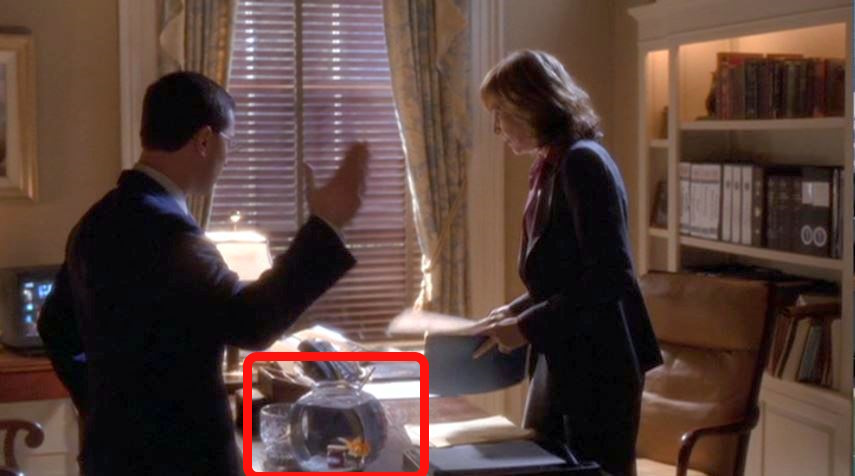
- Here's Gail's fishbowl, but I can't tell what's supposed to be in it.


- Why'd They Come Up With Things Fall Apart?
William Butler Yeats' poem The Second Coming includes the famous phrase "Things fall apart; the centre cannot hold." His poem serves as an allegory about post-World-War-I Europe, evoking images of the Apocalypse and the return of Christ. So, therefore, the chaos and uncertain future being presented in this episode - in both the prospect of a brokered convention and the leak about the military shuttle - certainly illustrates the phrase, "Things fall apart."


Quotes    
Josh: "Boil your message down to the title of a bad TV show."

Will: "Careful, it was formative for many of us."

Josh: "Formative?"

Will: "Crush on the mom."

Josh: "Very Mrs. Robinson. Were you, eight?"

Will: "Eh, she seemed knowing."

Josh: "Eight kids."

Will: "Maybe not so knowing about contraception."

-----

Josh: "The best argument is, it sets you up as the consensus front-runner in either four or eight years. The nomination would be yours."

Helen: "Or you're so tainted by association when Vinick cleans Russell's clock you can't run for dogcatcher."

(Matt turns, looks at Helen)

Josh: "I don't think anyone elects dogcatchers any more."

Helen: "My dad ran for dogcatcher."

Josh: "Really?"

Matt: "No!"

----- 

Kate (coming up behind CJ and Charlie): "Hey."

CJ: "Is for horses. Thank you, Granny Cregg."

Kate: "You can take a girl out of the Midwest ..."

CJ: "As fast as her little feet can fly, or not so little."

-----

Sullivan (on TV, speaking at the convention): "My fellow Americans, the body politic is ailing."

Josh (watching at the hotel bar): "You're not going there."

Sullivan: "We have businesses paralyzed by overregulation."

Josh: "Tell me you're not going there."

Sullivan: "Our international profile is a shadow of our former strength."

Donna (coming up next to Josh): "Is he doing what I think he is?"

Sullivan: "Our foreign policy stumbling from one crisis to another."

Donna: "The MS, he's invoking the MS."

Sullivan: "... progressively falling apart before our very eyes."

Josh: "This is going to backfire."

Sullivan: "A Defense Department that's enfeebled ..."

Donna: "Maybe people won't get it."

Sullivan: "... so clogged with complications it's positively sclerotic."

Donna: "Okay, they'll get that."

-----

CJ: "Would he have been okay sacrificing himself for national security?"

Toby: "He would have insisted on it. (pause) But don't ask me what I would have insisted on."


Story threads, callbacks, and familiar faces (Hey, it's that guy!)
  • It's flashback time! Here's Michigan Rep. Darren Gibson (David St. James), who we first saw in Bartlet For America trying to out Leo's 1998 alcohol relapse during the hearings over Bartlet's MS coverup. We also saw him on MSNBC in The Dover Test ranting about the President's Gaza peacekeeping plan. It's so cool to have the same actor appear over different seasons to give us a feeling of reality and consistency.

  • Governor Eric Baker (Ed O'Neill) reappears. First mentioned in The Hubbert Peak as the potential frontrunner for the Democratic nomination, Baker first appeared in A Change Is Gonna Come when President Bartlet donated his 25th Amendment letter to the National Constitution Center, and again in In The Room when he announced he would not be running for President due to personal family reasons. Those reasons must not be stopping him from considering the VP spot, I guess.

  • DNC chairman Steve Rorsche is played by Mark L. Taylor (Melrose Place, Saving Grace, Innerspace, Honey I Shrunk The Kids).

  • Dylan Clark, Hoynes' representative at the meeting with Leo, is played by Tim Kelleher (Thirteen Days, Independence Day, NCIS, Dark Skies).

  • I suppose she's still not all that excited about the prospect of becoming First Lady, but Helen instantly dismisses Russell's VP offer when Josh delivers it (remember, she was very reluctant about running at all in Faith Based Initiative, and leery about pushing too much and staying in too long in King Corn; she did agree to mortgage their house if need be before they won California in La Palabra, though, but that was to keep Matt in the campaign until Texas). Also remember Josh and Matt seemed to consider a VP offer totally out of reach in Opposition Research, yet here they are, and they're not instantly leaping on board (although with good reason, "too much voltage at the bottom of the ticket" and both of them recognize Russell can't beat Vinick).
  • Kate makes a remark about taking "a girl out of the Midwest" when talking to CJ. As we saw in The Long Goodbye, CJ is a native of Dayton, Ohio.
  • Ray Sullivan's thinly-veiled remarks on President Bartlet's weakness (pretty much explicitly bringing up his multiple sclerosis) is based on Jed's health arc that began in He Shall, From Time To Time ... and came front and center at the end of Season 2. The disease really had little impact on the President (except for Election Night) until A Change Is Gonna Come, and has been an important factor since then.
  • Josh and Donna's conversation makes us think about their long history together, from Pilot when Donna brought Josh coffee for the first time (as he was facing his potential firing for something he said on TV) - or even from the first time she shows up in New Hampshire and just starts answering phones in In The Shadow Of Two Gunmen Part II. When Josh asks her how she got to be so good at political strategizing, she responds, "I had a good teacher," by which she means she learned it all by watching Josh work.
  • Charlie and Zoey first met in The Crackpots And These Women, and began dating shortly after. Their relationship was the motivation for the Rosslyn shooters in What Kind Of Day Has It Been/In The Shadow Of Two Gunmen, although Zoey pretty much disappeared after The Midterms. She returned for Holy Night, now in a relationship with the skeevy French royalty Jean-Paul; Charlie pledged to fight to get her back the rest of that season, especially in Inauguration: Over There, and was particularly distraught after Jean-Paul's drugging of Zoey was a factor in her kidnapping in Commencement. They seemed to be quite friendly in Abu el Banat; Charlie was trying to rekindle their relationship in The Hubbert Peak, and it must have worked as he was sitting next to Zoey at her birthday party in In The Room, and now they are in a full-fledged physical boyfriend-girlfriend thing that Charlie wants to move even further forward with.
  • In the meeting with Annabeth we see the usual reporters Chris, Steve, and Greg Brock. In addition there's the female reporter played by Joyce Guy I first remember from Access (but she's actually credited for five appearances before this, back to Constituency Of One).
Chris

The reporter billed as Charlayne and Steve

Greg Brock
  • A quick shot of Nancy ushering Leo into the Oval Office. Played by Martin Sheen's daughter RenĂ©e Estevez, Nancy is credited for appearing in 44 episodes.

  • The Jed Bartlet jacket flip appears. Martin Sheen's left shoulder was injured at birth, making it difficult for him to lift that arm above this shoulder, so he developed this method of putting on jackets.

  • When the campaign representatives are fighting in front of Leo, we hear Josh asking for the California delegation to be up front, reminding us that Matt won the California primary in La Palabra; we also discover Russell won Texas, Hoynes' and Santos' home state, which is a bit interesting considering the importance Matt put on staying in through the Texas primary.

EDIT: I completely messed up the Texas reference. Josh is pulling for Texas to be up front ("spirited, boisterous") because Matt won his home state; it's Will who's dismissing them to the back. And Dylan's remark about disrespecting Hoynes' home state (Texas) followed by Will saying, "The Vice President won his home state" means he's referring to Russell's home state of Colorado, not Texas. So I read that totally wrong.


DC location shots    
  • None, although there are several establishing shots of the White House used in this episode. In case we forget where we are, I guess ...


They Do Exist! It's The Real Person, or Thing    
  • Josh says about the Ohio governor's speech at the Republican convention, "It's Lincolnesque - boil your message down to the title of a bad TV show." By which he means ...
  • Eight Is Enough, which is part of the chant Governor Reed starts at the convention and was an ABC TV show from 1977 to 1981 (although as Will says, it wasn't exactly bad).

Gov. Reed (on TV at the convention, leading the chant): "What say we?"

Leo (watching TV with Charlie in his office): "Would eight, perhaps, be enough?"

(We hear the convention goers shouting "Eight is enough!")

Charlie: "Uncanny."

Leo: "Psychic."

  • Josh then goes on to compare Will's attraction to the mother in the show with Mrs. Robinson, from the 1967 film The Graduate.  
  • There are cans of A&W soda and Diet Pepsi on the table in Matt's suite.

  • Ronna says guys Josh's age have a thing about (Bob) Dylan when he says something about "if wishes were horses." Josh and Matt turn that back on Ronna:

Josh: "And yes, I believe, that somewhere in the back of his deeply deluded political mind he imagines, 'Deadlocked Convention.' A nation turns its lonely eyes to Hoynes."

Matt (to Ronna): "Simon and Garfunkel."

  • There's mention of last week's Time cover (exploding donkey, Dems in disarray). The MSNBC logo appears, and Annabeth says Brock's story on the military shuttle will appear in the New York Times.

MSNBC

  • CJ makes a quip about Grand Ole Opry broadcasts in the Situation Room.
  • A Dunkin Donuts coffee cup is seen on the table with the reporters and Annabeth. 

  • Leo compares the chaos of the upcoming convention to professional wrestling, then mentions how nobody runs out and votes for the "the loudmouth in a leotard," to which Josh responds, "Outside of Minnesota." This would appear to be a reference to former professional wrestler Jesse "The Body" Ventura, who was elected governor of Minnesota between 1999 and 2003.
  • CJ exclaims to Leo, "This is Alice in Wonderland" as she's talking about the refusal to use the military shuttle to rescue the ISS crew.


End credits freeze frame: Donna, Russell, Santos, and Will all reacting to Josh's joke about "three feet on the floor at all times."


Previous episode: In God We Trust
Next episode: 2162 Votes

Thursday, December 21, 2023

In God We Trust - TWW S6E20


Original airdate: March 23, 2005

Written by: Lawrence O'Donnell (12)

Directed by: Christopher Misiano (23)

Synopsis
  • Questions of the separation of church and state cast a shadow over Senator Vinick as he locks in the Republican nomination, amid questions over his Vice Presidential choice and his own churchgoing. A bill to raise the debt ceiling and forestall an economic crisis is caught up in political wrangling over the minimum wage.


"If you demand expressions of religious faith from politicians you are just begging to be lied to." 


Religion and government have been inextricably linked since, well, religion and government have existed. There's just an irresistible urge to take the instilled faith-based rules-following of religion and apply it directly to governing your subjects ... and it's been a staple of human history from the beginning. Thanks to Enlightenment thinkers like Thomas Jefferson, the United States began with a rather bold approach - to separate church and state, to erect a "wall" of sorts between religion and government. The First Amendment, saying "Congress shall make no law" establishing any religion or restricting freedom to exercise one's religious rights, was groundbreaking in many ways. 
 
It's a good idea, especially for a diverse, growing nation with new citizens arriving from across the globe, all with different religions and different creeds and different beliefs. A government of such a nation should be established on evenhanded laws and rules that apply to all such citizens, and not restrict those citizens to have to live under the rules of one particular religion. In practice, though, it's been a challenge for American politicians to stick to that approach. The siren song of practicing one's Christianity through political means (and let's face it, it's almost always Christianity) is oftentimes too attractive to deny, and that's not even including the entry of pastors and reverends and other religious figures into politics themselves. It's hard for a preacher to run for office and then not, you know, continue to preach and try to use their newfound government power to enforce those religious precepts they have been urging their congregations to follow!

This is a conflict that's been with our nation from the beginning, the conflict between the "rightness" of religion and the messy freedoms of American life, and the political lure for religious leaders to use government to dictate that "rightness" to everyone, whether or not they actually follow that specific religion. It's always been a factor in the political landscape, sometimes coming to the forefront, sometimes pushed into the background - and we currently see it forced full front-and-center, with issues like abortion, banning certain books in schools, providing public funds for private religious schools, this month in particular being outraged about a Satanic Temple display sharing space with a Christian Christmas display in the rotunda of the Iowa Capitol, and denying the very humanity and personhood of those some don't agree with (LGBTQ students, for example). Even with the First Amendment and Jefferson's "wall of separation between the church and state," the United States can't seem to agree on that being the correct approach, and oftentimes wants to ignore those Enlightenment principles in order to impose religious ones.

All of that makes this episode not only ever-timely, but incredibly refreshing. Senator Arnie Vinick, a solid Republican conservative who has won the party's nomination for President in the upcoming 2006 election, is faced with somewhat of a dilemma - betray his own personal beliefs in order to pander to the anti-abortion right in the Republican base, and make a show of religion and churchgoing to get those votes, or stand strong on his own moral foundation, even if it doesn't align with the general religiosity of the party. He stays true to his own beliefs in this episode, in this West Wing universe, and we are meant to approve and appreciate his position - unfortunately, this type of stance has become vanishingly rare in today's politics. Which is what makes this refreshing, it's a sign of what could be, instead of what we are living through.

There's two tracks (well, three, kind of, but the third is linked to the other two) in this episode. We are closing in on the end of the season and the end of the primary campaign - in fact, the New Jersey primary that opens the episode feels like the final preliminary contest. While Vinick has locked up the Republican nomination, the Democrats are still a mess, with nobody earning enough delegates to ensure the bid going into the national convention in just a few weeks.

The big California win by Matt Santos that we saw in La Palabra lit a fire under his campaign, and with his narrow win in New Jersey he's fewer than a hundred delegates behind the frontrunner, Vice President Bob Russell. The other contender, former Vice President John Hoynes, cratered after his latest sex scandal blew up (also in La Palabra) and he's a distant third ... but with no one close to the 2162 delegates necessary, a lot of things can happen.

Toby in particular is worried and frantic about how much in disarray the Democrats appear to be, not even able to settle on a candidate for President (and we've seen in the past how little he thinks of Santos). In discussions with President Bartlet it's decided the President needs to step forward and show the country that the Democrats are currently head of the executive branch, and still know how to run the country - so he calls Santos and Russell in to the Oval Office for a photo op.
Toby: "You going to try to broker a deal between these guys?"

President: "Eh, not ready for that. Just a photo op. And remind people that we still know a little something about running the country."

Toby: "Maybe a little less about running a party." 


Once the press is gone, Bartlet lays down the law to the two candidates: no going negative, no attacks on each other, stay positive and stay focused on winning the general election, whichever of the two it might be.
 
In the background of all this is the debt ceiling, a limit which the government is fast approaching and needs raised before defaulting on its loans and causing a worldwide financial panic. Democrats float the idea of adding an amendment increasing the minimum wage to the debt ceiling bill, forcing the Republicans to vote to raise the wage or else crash the economy.

Charlie (on the debt ceiling bill): "It's a one-sentence bill. Just changes the seven to an eight."

Annabeth: "Trillion."

Toby (chuckling): "Yeah, trillion ..."

Annabeth: "Why does Treasury want the President to read over a 20-page memo on a one-sentence bill?"

Toby: "Well, they like to run the worst-case scenario."

Annabeth: "In case it doesn't pass?"

Toby: "Yeah, you know, the immediate collapse of the U.S. economy, followed by Japan sinking into the sea, followed by a worldwide depression the likes of which no mortal can imagine ... followed by week two."

The big focus of the episode, though, and the real good stuff inside, is all Vinick. Even with the Democrats fighting over their nomination and the debt ceiling crisis, this is a very Vinick-centric episode, and it earned Alan Alda an Emmy nomination.

With Vinick's clinching of the nomination, his immediate attention turns to picking a running mate. His main challenger in the primaries, Reverend Don Butler, is a staunch pro-life religious leader ... while his political positions don't line up that well with Vinick (a conservative, true, but a California conservative who still supports some abortion rights), Vinick's advisers tell him Butler as the VP candidate will bring the right wing of the party fully onboard with Vinick's candidacy and ensure a win in November.

Vinick is reluctant, but open minded. He knows Butler can lock up the White House for the Republicans, but he really wants to reach the independents and the more conservative Democrats, too. A surprising visit by Democratic campaign operative Bruno Gianelli (who ran Bartlet's 2002 campaign, remember) reinforces Vinick's own feelings on the situation.
Bruno (to Vinick): "Look - they don't know it yet, you are the best thing to ever happen to them. You're moving the Republicans away from the right wing. You're not saying Democrats are not patriotic; you're just saying that your approach is better than theirs. You are making politics a fair fight again. [...] I have spent the last twenty years ripping this country apart. Finding wedge issues to separate the voters. You don't have to do that to win. Not this time. You do this right, you can do a lot more than win. You can stop using politics to divide this country. You can show us how much we agree, instead of how much we disagree. You can put this country back together."
There's another very good option for VP, West Virginia governor Ray Sullivan, but he's not a pastor and not a guarantee to bring the far right into the fold in November. So when Butler comes to visit, Vinick can't resist the knowledge he would ensure the win, and he starts to offer him a spot on the ticket ... until Butler stops him.

It's a turn of events for us, the viewer ... we've been led to think of Vinick as someone solid in his beliefs, not a political flip-flopper, but suddenly we see he's willing to cave on some of his principles to get what he wants. It's Butler who stands firm and refuses to compromise, Butler who tells Vinick he can't serve alongside someone who supports abortion rights at all. Quite the reversal for us.

Then as Butler leaves Vinick's office, a reporter asked a different type of question - will he pray for Vinick to change his mind on abortion? Caught by surprise, Butler says yes, and then also says he'd welcome Vinick to come to his church to pray any time he wants to.

And therein lies the rub. Vinick, already viewed with suspicion by the religious right for his abortion stance, is now being publicly challenged to go to church, to make his Sunday morning religious practice a show for the news and for those religious voters. His staffers are generally in favor of doing that, of compromising yet again to fish for votes. But Sheila's hallway conversation with Bruno helps her see that's not the way to go - you can't try to run a political game on Rev. Butler to get his endorsement, he's not actually a politician (and as we saw, he's more certain of his noncompromising moral stance than Vinick is).

Senator Vinick's reasoning for not going to church is a deeply personal one. As his wife grew ill, he stayed home to care for her; after she died, he didn't want to go back to the church where her funeral was held (and there's an underlying unspoken message about losing some of his faith when that faith couldn't save his wife). Even so, out of the mouth of Sheila's young daughter comes the question that this churchgoing issue is going to bring to the forefront:

"Do you believe in God?"

Vinick doesn't really have a good answer for her (even though she says it's okay, one of her friends doesn't believe in God and she's cool).


Anyway, with Butler out the obvious choice is Governor Sullivan, and he's happy to be onboard, saying "I go to church enough for the both of us." But Butler's invitation continues to loom over the campaign like a giant shadow, trapping Vinick in a moral conundrum.

Then comes another invitation, one from the President himself. Vinick is summoned to the White House to try to work out a deal on the debt ceiling bill, as the midnight deadline draws near. The two political titans square off, with stern looks and strong words (in the DVD commentary writer Lawrence O'Donnell and director Christopher Misiano recall how difficult it was to get that tone on camera - Alda and Martin Sheen liked each other so much they had too much fun and too much camaraderie to get that tension onscreen). But Vinick has an offer, as long as he can get what he wants out of it - he'll split the minimum wage amendment off the debt ceiling bill, pass the debt ceiling increase, then get the minimum wage bill passed separately:

President: "What do you want from me?"

Vinick: "I announce the deal."

President: "I know a few Democratic candidates for President who wouldn't be happy watching you take credit for this."

Vinick: "Well, then, then let them pass the debt ceiling for you and get you the minimum wage increase."

Since that didn't take long, Vinick says he'll stick around so it looks like they're really hammering out a deal. And maybe, while they wait, could he have some ice cream?

Hence one of the memorable scenes in West Wing history. President Bartlet and Senator Vinick, in the back of the White House kitchen, hauling out three-gallon buckets of ice cream and talking about religion. 
 

(While it's a great scene, think of the health violations here, as both these guys dig into multiple containers of ice cream with their spoons, contaminating who knows how many gallons of the stuff.)
 
It's a tremendously well-written scene, with the staunch Catholic Bartlet and the somewhat agnostic Vinick really getting pretty deep into religion and politics and how they're connected and why they shouldn't be. This talk really becomes a turning point for Vinick, even as we get yet another story about why he doesn't go to church - this time he talks about a collectors' edition of the King James Bible he received as a gift, and how once he started reading it he really couldn't believe everything that was in there. And some of this reminds us of the verbal beatdown President Bartlet gave Dr. Jenna Jacobs in The Midterms.
Vinick: "It was a thrill just to hold it. Then I read it."

President: "You can't take it literally."

Vinick: "That's what my priest friends kept telling me. But the more I read it, the less I could believe. I could not believe there was a God who said the penalty for working on the Sabbath was death. I couldn't believe there was a God who said the penalty for adultery was death."

President: "I'm more of a New Testament man myself."

Vinick: "I couldn't believe that there was a God who had no penalty for slavery. The Bible has no problem with slavery at all. Lincoln could have used a little help from the Bible."

The President leaves Vinick with a little tidbit of advice that really gets to the essence of religion and politics, particularly the Presidency:

President: "The only thing you can pray for in this job is strength to get through the day. You can try coffee if you want, but prayer works better for me."
 
Vinick goes out on the White House lawn, to announce the deals on the debt ceiling and the minimum wage. When a reporter asks about Rev. Butler's invitation yet again, he first sticks to the simple, noncontroversial, noncommital response his staff told him to use:

Vinick: "I fully respect Reverend Butler's position. I mean, I appreciate his invitation, and, uh ..."

There's a pause. His talk with President Bartlet has spurred him to stick with his own moral position, however he arrived there - and to defend everyone's right to practice religion, or not, in their own way, and to criticize any effort to make any kind of religious test a requirement for public service.
 

Vinick: "Look, I respect Reverend Butler. And I respect his church too much to use it for my own political purposes. And that's exactly what I'd be doing if I went down there this Sunday, because the truth is it would just be an act of political phoniness. I may be wrong, but I, I suspect our churches already have enough political phonies in them."

(Reporters shout out questions)

Vinick: "I don't see how we can have a separation of church and state in this government if you have to pass a religious test to get in this government. And I want to warn everyone in the press, and all the voters out there - if you demand expressions of religious faith from politicians you are just begging to be lied to. They won't all lie to you, but a lot of them will. And it will be the easiest lie they ever had to tell, to get your votes. So every day until the end of this campaign, I'll answer any question anyone has on government - but if you have, if you have a question on religion, please ... go to church. Thank you."

It is a fantastic statement defending the separation of church and state, clearly laying out where Senator Vinick stands, and defining where every American politician ought to be. They ought to be protecting the rights of all religions, all faiths, all beliefs (even nonbeliefs), not imposing some kind of Christian framework on questions of government action and enforcement of laws.

Too bad that didn't stick with us into 2023. Maybe we'll have Republican politicians like this back again, someday. Maybe.


Tales Of Interest!

- We have clearly moved on from the early spring/Super Tuesday primaries depicted in La Palabra and Ninety Miles Away and headed into the summer. We can tell because 1) the primaries are essentially finished with Senator Vinick locking up enough delegates to secure the Republican nomination and the Democrats having over 4200 delegates split between Vice President Russell, Representative Santos and former Vice President Hoynes, with only a few hundred left undecided; 2) the New Jersey primary is the hot topic, a primary which was held in June in 2004; 3) a couple of times it's mentioned the Democratic National Convention is a month away, a convention that always held in the summer (the 2004 DNC was in late July, the 2008 convention was in late August); 4) Sheila is trying to take her daughter to a baseball game (unknown whether they're talking about the Baltimore Orioles or the Washington Nationals, who played their first season in DC in 2005); and 5) most obviously, Charlie has grown facial hair since we last saw him talking about Leo's secret trip to Cuba. 
 

- The discussion in CJ's office about the debt limit - how Congress likes to hold off on a vote until the last minute, making legislators decide between voting for an increase or a government default, as well as preventing amendments - remains eerily accurate nearly 20 years later in our current world of 2023. Only thing is, unlike then, now we have Republican Congresspersons who are totally willing to let the government default while they make their own political points.

- Toby lists off the delegate count - Russell has 1677 delegates, Santos has 1599, and Hoynes is holding 956. With 2162 needed for the nomination and only a couple of hundred left undecided, there's still a lot to figure out.

- We see Sheila juggling her duties as Vinick's chief of staff and her responsibilities as a mother. There's a nice little moment in the limousine where she's on the phone with a staffer, but hands that phone over to Vinick as soon as one of her children calls with a homework question; then she retrieves the business phone from the Senator as soon as she's done. In the DVD commentary O'Donnell said his writing of Sheila's character was inspired by Sheila Burke, chief of staff for Senator Bob Dole and a friend of O'Donnell's when O'Donnell was working in the Senate - Burke had three children and also juggled family responsibilities with her work, much as we see here.

- There's something in Gail's fishbowl, but I can't quite tell what it is. It almost looks like a small jar of jelly or jam or something like that.


- If you pay attention during Vinick's talk to the press outside the White House, he answers a question on Reverend Butler with the exact four words (or is it five?) that Bob told him he needed to keep hammering to make the topic go away - "I fully respect Reverend Butler's position." Then, of course, he goes on to say a whole lot more, in one of the best little speeches in West Wing history.
 
- Alan Alda was nominated for an Emmy for Outstanding Supporting Actor in a Drama Series for this episode and King Corn. The award went to William Shatner for his role as Denny Crane in Boston Legal.

- Why'd They Come Up With In God We Trust?
It's the official motto of the United States, and its usage there shines a light on Senator Vinick's reluctance to use religion or belief in God as a political tool, as so many of his advisors believe he should.


Quotes    
Leo (watching Vinick prepare to give his victory speech): "We've got nobody who can beat him."

-----

Sheila: "Now these energy types that are going to be there tonight, obviously they're going to want to hear how you're voting on the energy deregulation bill."

Vinick: "Well, it depends on what's in it when it comes out of committee."

Sheila: "Sends a very bad message to the big contributors if you vote against it."

Vinick: "Hey, if you can't drink their booze, take their money, and then vote against them you don't belong in this business."

----- 

Vinick: "How do we spin this thing?"

Bob: "You say that you fully respect Reverend Butler's position that he's not interested in VP. In fact, you just keep repeating those four words - 'fully respect Reverend Butler's position.'"

Staffer: "Five words."

----- 

Vinick (talking to Sheila about church): "I used to go with my wife every Sunday I was in California, and when she got too sick to go I stayed home with her. (pause) And after her funeral I didn't want to go into that church again."

-----

Vinick: "You think the voter really needs to know if I go to church?"

President: "I don't need to know, but then I'm not gonna vote for you anyway. (pause) It's not up to us to decide what the voters get to use in evaluating us."

Vinick: "A little odd, coming from someone who wasn't exactly completely open about his health."

President: "That was a big mistake."

Vinick: "Was it?"


Story threads, callbacks, and familiar faces (Hey, it's that guy!)
  • This is the first we've heard of Reverend Don Butler (Don S. Davis, known for Stargate: SG-1, A League Of Their Own, Twin Peaks) as a candidate for the Republican nomination. We've previously known as candidates Glenallen Walken (Speaker of the House and acting President in Twenty Five through The Dogs Of War), and an "Allard" was mentioned in King Corn ... but that's about the only names we've heard mentioned before.

  • Bruno Gianelli is back, and this time he's working for the Republican Vinick. Bruno (Ron Silver) famously was the top-notch campaign director hired by the Bartlet campaign to guide the reelection effort through the troubled waters of the MS disclosure, which he did quite successfully. Bruno's arc with the Bartlet campaign started with Manchester and he was last seen in Process Stories.


Bruno's party switch, and his professed reasons for supporting Vinick, are somewhat in opposition to his partisan, hit-back-harder approach he talked about in Gone Quiet.

Bruno: "Cause I am tired of working for candidates who make me think I should be embarrassed to believe what I believe, Sam. I'm tired of getting them elected. We all need some therapy, because somebody came along and said 'liberal' means soft on crime, soft on drugs, soft on defense, and we're gonna tax you back into the Stone Age because people shouldn't have to work if they don't want to. And instead of saying, 'Well, excuse me, you right-wing, reactionary, xenophobic, homophobic, anti-education, anti-choice, pro-gun, Leave It To Beaver trip back to the fifties,' we cowered in the corner and said, 'Please don't hurt me.' No more. I really don't care who's right, who's wrong. We're both right, we're both wrong. Let's have two parties, huh?"

That doesn't sound exactly like a guy who's going to celebrate a Senator Vinick who's "pro-business" and "anti-tax," even if that's where most of the voters are. Ron Silver, of course, was a proud right-wing conservative as a person, even as he could portray liberals in a convincing manner onscreen - I don't know if that had anything to do with Bruno's switch or not.

  • Our introduction to Vinick's running mate, West Virginia Governor Ray Sullivan (Brett Cullen, known for Falcon Crest, The Dark Knight Rises, Narcos, Person Of Interest), and a religious figure in his own right. 

  • Leo's remark to President Bartlet about Vinick - "We've got nobody who can beat him" - is a reminder of his conversation with Josh in In The Room.

Josh: "Republican who wins California wipes us out in the electoral college."

Leo: "Right."

Josh: "He's not getting the nomination."

Leo: "If he does ... we've got no one who can beat him."

  • We hear CJ call the Secretary of the Treasury "Madam Secretary" - we saw Treasury Secretary Karen Browning on TV in Third-Day Story.
  • Toby talking about the networks loving the disarray at the upcoming convention reminds us of The Black Vera Wang when Toby was furious at the networks planning to cut back their coverage to just one hour total for each convention.
  • When Vinick's staff is talking about which Democrat they'd rather face one staffer says, "Santos didn't even win his own state." In La Palabra we saw how much staying in the race until the Texas primary meant to Matt ... this is the first we've heard that he didn't win there. That also reminds us that the Bartlet campaign decided on John Hoynes as VP in order to win the South, yet Hoynes didn't bring along his home state of Texas in the general election of 1998.
  • Governor Baker is mentioned by Sheila as vouching for Bruno. Eric Baker, governor of Pennsylvania, was the presumptive frontrunner for the Democratic nomination before he announced he wasn't running for personal family reasons in In The Room.
  • When President Bartlet verbally spanks both Santos and Russell in the Oval Office, telling them to lay off the personal attacks or he might endorse the other guy, we are reminded that in Freedonia Matt Santos specifically refused to go on the attack at all, and only conduct a positive campaign about his own policies.
  • As they chow down on ice cream Vinick asks President Bartlet, "How's your health?" to which Jed replies, "Good days and bad days." Vinick later points out the fact that President Bartlet wasn't completely open about his health while running for President. This is a reference to President Bartlet's multiple sclerosis, which has been an underlying issue ever since we first found out about it in He Shall, From Time To Time ... and has been more evident since A Change Is Gonna Come.


DC location shots    
  • There aren't any, but once again we see the Los Angeles City Hall standing in for what is supposed to be the US Capitol. The City Hall building has been used numerous times before, including Swiss Diplomacy, A Good Day and tons of other times.

  • We also get an establishing shot of what is supposed to be the Senate Office Building containing Senator Vinick's office. Thing is, though, that's actually the headquarters of the Environmental Protection Agency on 12th Street NW, across the street from the Old Post Office and closer to the White House than it is to the Capitol. Funny thing, too, not only did they use that building as the place where Donna was giving her deposition in War Crimes ... but it's the exact same B-roll establishing shot, reused from four years prior.

This is from War Crimes

This is from this episode - obviously the exact same footage.


They Do Exist! It's The Real Person, or Thing    
  • Stevie Wonder's "Sir Duke" is heard playing at the Vinick victory party.
  • Reverend Butler is based on Republicans like Pat Buchanan or Reverend Pat Robertson who ran for president on far-right religious platforms in the late 1980s and early 1990s. That has continued for Republicans in more recent years with candidates like Mike Huckabee or Mike Pence, for example.
  • CJ asks Toby if he's seen Broder's column. That would be David Broder of The Washington Post (we see a blurry front page of the Post held by CJ).

  • Bruno mentions that a Republican presidential candidate has won 49 states twice in the last 30 years (which would be going back to 1976). In reality, it happened in 1972 (Richard Nixon won every state except Massachusetts [and the District of Columbia]) and in 1984 (Ronald Reagan won every state except Minnesota).
  • We see some TV screens with MSNBC and C-SPAN2.
MSNBC

C-SPAN 2
  • As the President and Vinick talk about the minimum wage bill, Vinick says California's minimum wage is "a buck fifty higher" than the federal minimum wage. In 2005 the federal minimum wage was $5.15 per hour, while California's was $6.75 - $1.60 higher. By the way, even that $5.15 wage in 2005 would equate to $8.29 in 2023 dollars, while the current federal minimum wage has been stuck at $7.25 since 2010.
  • Vinick brings up Presidents Lincoln, Washington, Jefferson, and FDR as examples of candidates who didn't feel the need to answer health questions.


End credits freeze frame: The President and Senator Vinick meeting in the Oval Office.


Previous episode: Ninety Miles Away
Next episode: Things Fall Apart