Monday, April 6, 2020

Hartsfield's Landing - TWW S3E15


Original airdate: February 27, 2002

Written by: Aaron Sorkin (58)

Directed by: Vincent Misiano (2)

Synopsis
  • While playing a dangerous diplomatic game of chess with the Chinese government over a Taiwanese missile test, President Bartlet also plays literal games of chess with Sam and Toby. Josh and Donna work the phones to wring every last vote from a small New Hampshire town kicking off the state's primary election. CJ and Charlie engage in a prank war.


"See the whole board."


In my opinion, this is one of the most elegantly constructed scripts of television you're ever going to see. Aaron Sorkin rather masterfully conjoins President Bartlet's literal games of chess with a geopolitical chess match in the waters off the coast of China. He also uses those actual chess games to not only lay the groundwork for Sam's potential future, but also to bring Jed and Toby to common ground over their recent conflicts. And just when you think that's the point of the episode, we suddenly realize it's not really about chess or geopolitics or Jed's father at all - it's really been all about democracy, the voice of the people, and the sanctity of the vote.

That's a lot to unpack! But as I said, Sorkin knocks it out of the park with this one. Martin Sheen and Richard Schiff do some outstanding work here (Schiff actually earned his third consecutive nomination for a supporting actor Emmy in part for this episode), and that structure of the chess games playing out alongside the President's delicate move/countermove with the Chinese is done so very well.

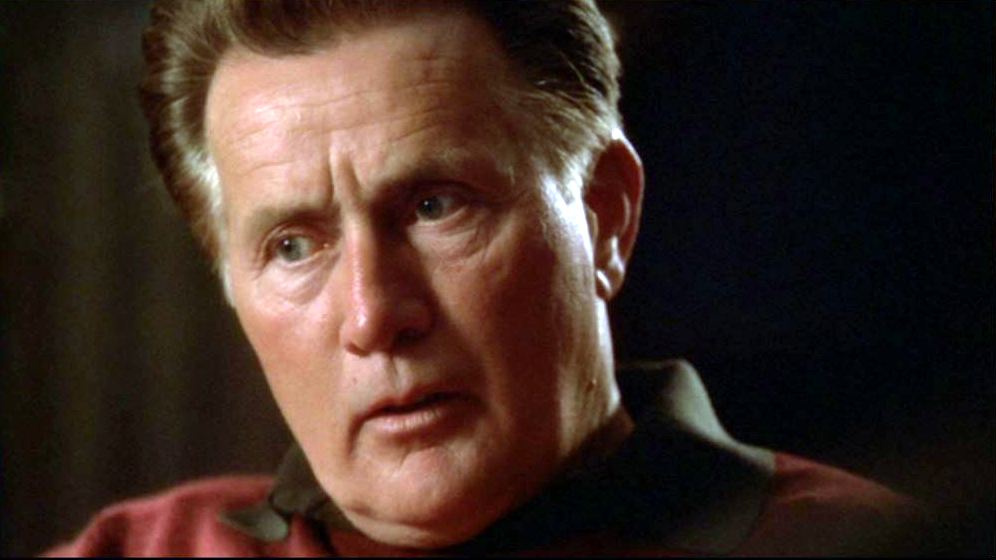
We begin with the President returning from a visit to India. He's brought back some chess sets, gifts from the Prime Minister, and he plans to hand them out to members of his staff as his gifts to them. Upon his return, we discover a crisis is brewing in Taiwan - the government there is planning a test of US-made Patriot anti-missile batteries, but China is not pleased with that show of Taiwanese military strength and is rattling its saber with an unprecedented military exercise of its own. A discussion ensues in the Situation Room about fleet readiness and availability, and whether the President should order Navy ships into the Taiwan Strait. The chess connection kicks off with President Bartlet ordering the ships to start heading that way:
President: "That's our next move."
McNally: "After that?"
President (pause): "After our next move comes their next move."
It's exactly like chess, although with much higher stakes. One nation makes a move, which forces a countermove by another, and then a response to that move ... and as President Bartlet keeps telling Sam, it's key to "see the whole board." One cannot focus on just the immediate response to the prodding by the other; to win, to succeed, you have to plan many moves ahead and have your goal firmly in mind.

Eventually it turns out that the President had a final checkmate move up his sleeve the entire time. The United States had announced an arms deal with Taiwan that included four Aegis destroyers, high-tech warships with extremely advanced radar systems. Bartlet was able to use those ships as pawns, removing them from the deal in order for China's agreement to back down on their war games - but as he later reveals, he never had any intention to actually sell those ships to Taiwan in the first place.

Bartlet's chess game with Sam serves the viewer as a pure reflection of the Taiwan crisis. Sam picks the President's brain about how things are developing, and the President in turn guides Sam down the path of looking ahead, planning your moves, anticipating your opponent ... and therefore being ready at the endgame for the real stakes your opponent is after. It's a nice showcase for Sam's intelligence and his readiness to take on a more personal role in governance - he's able to figure out all the pieces the President is playing with in his match of wits with the Chinese, and comes to the conclusion of the crisis on his own. Bartlet sees the wisdom and drive in Sam and gives him some high praise:
Sam: "I don't know how you ... I don't know the word. I ... don't know how you do it."
President: "You have a lot of help. You listen to everybody and then you call the play. Sam. You're gonna run for President one day. Don't be scared. You can do it. I believe in you." 


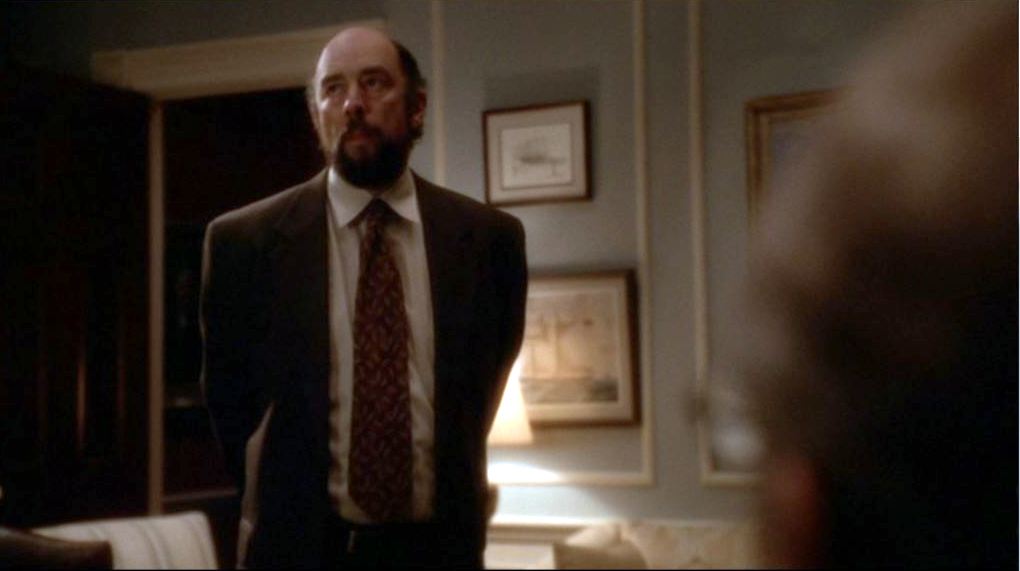
Meanwhile, the President's other game, with Toby, serves as a continuation of the tense battle of wills the two have had ever since Bartlet evaded Toby's desire to publicly defend affirmative action in The Two Bartlets. After that, Toby called the President out on his willingness to take the easy path, the likeable path, the less righteous and less divisive path in his campaign for re-election; and when Toby focused on Jed's unfulfilled need to be liked by his father as the impetus for the wishy-washyness, the President took umbrage. He also realized there was something to the criticism, which was covered to some degree in his conversation with Stanley Keyworth in Night Five. Here Jed pulls out the chessboard to use as a reset, of sorts, with his old campaign companion and to defend his position of being a more personable candidate ... but it doesn't quite go the way he planned:


President: "If a guy is a good neighbor, if he puts in a day, if every once in a while he laughs, if every once in a while he thinks about somebody else and, above all else, if he can find his way to compassion and tolerance, then he's my brother, I don't give a damn if he didn't get past finger-painting. What I can't stomach are people who are out to convince people that the educated are soft and privileged and out to make them feel like they're less than, you know, 'he may be educated, but I'm plain-spoken, just like you!' Especially when we know that education can be a silver bullet, it can be the silver bullet, Toby! For crime, poverty, unemployment, drugs, hate ..."
Toby: "Who are you trying to convince?"
President: "I'm saying I don't watch the pitch go by."
Toby (makes move): "Check."
President: "And if I do, it's not because my father -"
Toby: "Was an idiot."
President (sputtering): "Can we talk about ... God! Can we talk about, please, can we talk about my father with some respect? The man's gone, can we ... he's my father, he wasn't a Dickens character!" 
With that the President relentlessly chases Toby's king into check, again, and again, and again, using his chess prowess to try to make a point about power and responsibility and to teach Toby a lesson.

But Toby, to his credit, does not back down. He ends up encapsulating the essence of the campaign Bartlet needs to run, especially against a folksy, amiable, less-intelligent-seeming Republican opponent like the inevitable Governor Ritchie. Bartlet shouldn't lower himself to the level of that aw-shucks everyman, Toby says; he needs to stake out the difference between the two and illustrate to Americans why it's important:
Toby: "You're a good father, you don't have to act like it. You're the President, you don't have to act like it. You're a good man, you don't have to act like it. You're not just folks, you're not plain-spoken. Do not ... do not ... do not act like it."
President: "I don't want to be killed."
Toby: "Then make this election about smart, and not. Make it about engaged, and not. Qualified, and not. Make it about a heavyweight. You're a heavyweight. And you've been holding me up for too many rounds." 


At last, after all the emotional angst over his father and the anger at Toby calling him out about it, the President realizes Toby is still there on his side. He just wants Bartlet to be who he is, to show the nation why it's important to have intelligence and smarts and qualifications instead of an easygoing guy that you'd like to hang out with. And yes, I realize in the Trump era, this is a lesson that too many Americans failed to pay attention to in 2016.

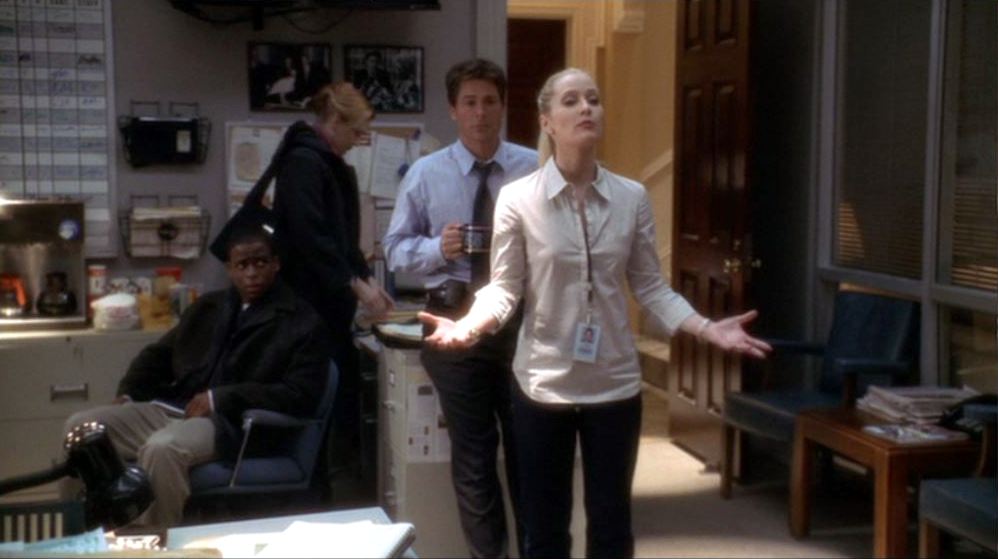
So while we're distracted with Sorkin's rather elegant cross-connection between chess and geopolitics, I think the real crux of the episode actually develops in New Hampshire. It's the night before the New Hampshire primary, and the little town of Hartsfield's Landing is getting ready for their traditional midnight vote. While the administration as a whole recognizes the general political advantage of doing well in that first primary vote, Josh is particularly hung up on winning the night as a key spark to revving up the re-election campaign as a whole. He enlists Donna to call a family in the town that had worked with them in the previous campaign, and when it turns out they may not be supporting Bartlet this time, he pulls out all the stops to try to get their votes.

A lot of this storyline is played for humor - Josh starts thinking about changing administration policy goals just to address this one family's concerns, and the issue of Oregon salmon being tied into this New Hampshire family is pretty funny - but it really, truly pays off at the end. You see, the entire Taiwan crisis isn't just about military exercises; their government is preparing to announce the first free and open elections in the island's history, and President Bartlet knows that's the real issue of concern to the Chinese. CJ has almost a throwaway speech that in retrospect may indeed be the point of the entire episode:
CJ: "I think it's democracy at its purest. They all gather at once -"
Josh: "At a gas station."
CJ: "It's not a gas station, it's nice. There's a registrar of voters, the names are called in the alphabetical order, they put a folded piece of paper into a box. See, this is the difference between you and me."
Josh: "You're a sap?"
CJ: "Those 42 people are teaching us something about ourselves: that freedom is the glory of God, that democracy is its birthright, and that our vote matters."
We need to see the whole board. Forget the chess; it's about democracy, it's about open elections, it's about the free will of voters choosing their representatives - not just here, not just in New Hampshire, but in Taiwan and everywhere that democracy doesn't exist yet. Sorkin has kind of faked us out, with his well-constructed script and chess-related storylines - it's personal choice and free will at the ballot box that lies at the foundation of this episode.

And Josh has been trying to circumvent that, with his negotiations and pandering to the Flender family of Hartsfield's Landing. He finally figures out, in connection with the might of the US military and the nimble moves and countermoves of the President to safeguard the emergence of democracy in Taiwan, that there are things more important than making deals to get every potential primary vote. He heads out into the cold night to rescue Donna from her quest to convince the Flenders:
Donna: "You know, I've kind of had it now, too: they're shocked and appalled and disappointed, but really, they're none of those things, they just wish they were. So, never miss an opportunity to feel morally superior ... I don't know. What do you want me to do now?"
Josh: "Let them vote."
Donna: "What does that mean?"
Josh: "I came out here to tell you to let them vote. (takes phone from Donna) Yeah, this is Josh Lyman. We just wanted to call and thank you again for all your hard work and remind you that the polls in Hartsfield's Landing open in fourteen minutes. Got the chains in the truck, Mack? Okay, listen, tell your sister in Oregon I'm gonna try to learn something about salmon. Right now, all I know is they're good on a bagel. Good night."
 And as the episode draws to a close, we see the staff in the West Wing hard at work late into the night, doing the things that need to be done to try to make the country a better place, juxtaposed with images on televisions of that first vote of the primary campaign season - that first expression of democracy, of citizens making their voices heard, and casting their ballots in a free and open society.


Sure, it's hokey. Sure, it ignores the ugly reality of politics and business and the underside of American life - but The West Wing is supposed to reflect a better version of ourselves, and this is a great example of that.

I can't get out of here without mentioning the CJ/Charlie prank war, even though it's the lightest of light subplots. After copies of the President's daily schedule turn up in the press briefing room, Charlie has instituted a sign-out procedure to more tightly control the document. CJ is offended by the increased oversight, and she hides Charlie's personal copy of the schedule as a prank. This, it turns out, was a mistake. Charlie responds by gluing CJ's phone handset to the base:


He somehow switches keycards with her, so when she comes back into the White House after picking up pizzas alarm sirens blare and security officers accost her; and finally, after they both are chewed out by Leo ("All right, I think it's fine that people blow off a little steam, but now it's done, and it's time for one of you to be mature," to which Charlie replies, "Well, God knows CJ's a lot more mature than I am"), CJ tosses a binder on her desk and discovers Charlie has sawed through the legs:


At which point CJ weakly asks, "So, how long do you usually make people your bitch?" Don't mess with Charlie.

This has been a good solid run of almost entirely solo Sorkin-written scripts, and he's really firing on all cylinders with this one. From the reflections of chess in military and diplomatic moves, to the declaration of what the campaign needs to be about, to the celebration of democracy and the power of the citizen in a free society, this ties a lot of important strings together. There's a few more episodes left before we go full-bore into the windup of Season 3 - just as Season 1 wrapped up with the chaos at Rosslyn and Season 2 finished with some of the greatest TV episodes of all time, this season is also going to climax in a terrific finale. Stay tuned.


Tales Of Interest!

- The Prime Minister of India has changed since Lord John Marbury. In that episode, dealing with a potential nuclear crisis between India and Pakistan, the Indian Prime Minister is referred to as "Ricky" Nohamid. President Bartlet refers to the Prime Minister as a woman multiple times in this episode.

- The fictional Hartsfield's Landing and its midnight voting is a direct reference to the real-life Dixville Notch, New Hampshire. However, Dixville Notch could not be said to be predictive of presidential winners since William Howard Taft like CJ claims, as their first-to-vote tradition only started in 1960. The candidate receiving the most votes there did win the eventual Republican nomination every year between 1968 and 2012. Also, while Josh mentions the 42 voters in Hartsfield's Landing, Dixville Notch had just 26 registered voters in 2004, and only five for the 2020 primary election.

- Josh and Donna's efforts to change Mackey Flender's vote from the Republican Ritchie to the Democrat Bartlet on voting day could actually be possible for the New Hampshire primary, as long as Flender was registered as "undeclared." While some states have closed primaries (only voters registered for a party can vote in that party's primary) or open primaries (voters can choose whichever party's primary they wish to vote in), New Hampshire is kind of a hybrid - while voters registered for a particular party can only vote for that party's candidates, "undeclared" voters can choose a party to vote in at the polling place.

- The President's assertions about chess openings are, as you might guess, mainly designed to rattle Sam. The "Fibonacci opening" he claims Sam is using does not exist, nor does the "Balducci opening" he tells Sam that Toby is using. With Toby, however, who appears to be a more experienced chess player, President Bartlet mentions the Evans gambit, as a variation on the Giuoco Piano opening. Those do exist (and while Toby scoffs about the Evans gambit being a real thing, as the President says it was indeed invented by a sea captain in the 1820s), although to be honest, there's no way Jed could have known that was Toby's opening from the first move alone.

- We do get a closeup of Gail's fishbowl as CJ feeds her, but we can't really see what's in there. It looks like a gold giftbox, so perhaps it's a reference to the chess set gifts the President is handing out.


- The trademark West Wing shot of the camera spinning around the characters shows up in the scene where CJ is stopped by security after she uses Charlie's key pass to enter the White House with the pizzas.

- As I mentioned, Richard Schiff was nominated for the third straight year for a Supporting Actor Emmy award (for this episode and the previous Night Five); Dulé Hill was also nominated in that category for his work here as well as in the upcoming Enemies, Foreign And Domestic. John Spencer would end up taking that Emmy award. 


Quotes    
President: "Wanna play?"
Sam: "You?"
President: "Yeah."
Sam: "I'll get killed."
President: "Why?"
Sam: "You're a Grand Wizard, or a grandmaster, or something."
President: "No, I'm none of those things. I'm just grand." 
-----
CJ: "Think you're going to want to talk nicer to me than that, because when a reporter finds it, they're going to come to me, and that thing is stamped D12, and you signed out D12, and rules are rules."
Charlie: "Funny."
CJ: "What?"
Charlie: "I never said it was D12."
CJ: "How about that? You'll find it in your filing cabinet under 'A' for 'anal.'"
(Ed and Larry exchange a look as Charlie and CJ move away)

Larry: "I don't really want to know what he's going to find in his filing cabinet, do you?" 
Ed: "Nooooo." 
-----
Josh: "How'd it go?"
Donna: "I told them about the trade adjustment assistance."
Josh: "And?"
Donna: "They're not wild about the Canadian pulp thing but their real problem is the tax policy. They want to go from an income tax to a sales tax."
Josh: "Is this gonna end up with Mackey Flender as Fed chair?"
-----
President: "Let me tell you, you're really showing me something tonight. A lot of spunk, a lot of pluck, and this game isn't all about size, you know. There's a little thing called heart, and you've got it, my friend."
Toby (looking over the chess board): "You know what, old man? The very minute they swear in the next guy, you and I are going round and round." 
-----
President: "Let's go ahead and say the Republicans nominate Ritchie."
Toby: "They will."
President: "First of all, I'd stop for a moment and say, you know, 'why?'. I mean they got some serious guys in the field. Kalmbach, Daniel, Weston."
Toby: "Democrats had a lot of serious guys in the field, and they nominated you." 
-----
Leo: "I don't think you let the pitch go by."
President: "I don't."
Leo: "I think you foul it off."

Story threads, callbacks, and familiar faces (Hey, it's that guy!)
  • National Security Advisor Nancy McNally is back. It's always welcome to see Anna Deavere Smith in this role. There's once again talk of Joint Chiefs of Staff Chairman Admiral Fitzwallace (last mentioned in Two Cathedrals, but we actually haven't seen him onscreen since the end of Season 1).

  • The Chinese ambassador is played by well-known character actor James Hong (Big Trouble In Little China, Kung-Fu Panda). He previously appeared in the same role in Lord John Marbury.

  • The President congratulates Sam over his work on the State of the Union (seen in 100,000 Airplanes); the President tells Toby about seeing Dr. Keyworth after not being able to sleep for several nights (Night Five); the entire discussion with Bartlet and Toby focuses on the conflict they've had since The Two Bartlets.
  • While Donna is on the phone with Mackey Flender it's obvious the topic of the President deceiving the nation about his medical condition comes up (Donna says, "Well, he didn't lie. He didn't lie, Mackey, and I'll ... I'll tell you what else, the man just accepted a Congressional censure"). That coverup storyline was addressed throughout the final episodes of Season 2, with the public revelation in Two Cathedrals and the fallout throughout Season 3. The actual censure was seen at the end of H. CON-172.
  • While the President insists Sam is going to run for President one day, that doesn't actually turn into foreshadowing (yet - a lot of people are still hoping for a West Wing revival with President Seaborn). We will see Sam take a turn towards running for office next season.
  • The President's fondness for chess is a callback to Five Votes Down, when Congressman Wick asked for a game of golf with the President in order to ensure his vote for a bill and Josh told him Bartlet doesn't play golf, he plays chess.

DC location shots    
  • We get two two scenes filmed at the northwest gate of the White House grounds. This is the same gate used in Noël when Josh and Donna exit the White House while the bell choir is performing on Pennsylvania Avenue. That Season 2 episode was filmed with the cooperation of the Clinton administration in 2000, but big props to the George W. Bush administration giving the show access to the White House gate even after the heightened security stance following 9/11.


Here's one of the shots of that gate from Noël:


They Do Exist! It's The Real Person, or Thing    
  • The Situation Room conversation about warships in the Pacific names several actual aircraft carriers (although the Constellation was in service at the time of this episode, the Independence was decommissioned in 1998). The Nimitz and the Carl Vinson were named after real people (Admiral Chester Nimitz and Georgia Congressman Carl Vinson).
  • The Shanghai Communiqué brought up by the Chinese ambassador is a 1972 agreement between the United States and the People's Republic of China. It does indeed acknowledge the "One-China policy" that asserts there are not two separate nations using the name "China," but only one nation including both the mainland and the island of Taiwan. The agreement also allows some ambiguity for the US in their dealings with Taiwan.
  • President Bartlet's note to Toby called him "Sigmund," as in Freud - a reference to Toby's "psychoanalyzing" of the President in The Two Bartlets.
  • We can see former CNN anchor Jack Cafferty on a TV screen in Josh's office:

  • President Bartlet demands some respect for his father, saying he's not a Dickens character.
  • Sweden's King Gustaf appears in the story Toby tells about Bartlet receiving his Nobel Prize.
  • Sorkin likes his Broadway musical references: We hear CJ call Charlie "Marian the librarian" (a character and a song from The Music Man) when they are both yelling at Leo about who's responsible for the prank war.
  • Products - CJ says Charlie "Krazy Glued" her phone; Krazy Glue is a trademarked name. We also see her bringing in Pizza Hut pizzas to the West Wing (maybe an odd choice, considering DC must have a bunch of good local pizzerias - but since this was actually filmed in Los Angeles, you go with something recognizable, I guess - and I wouldn't be surprised if the production got some free Pizza Hut pizzas out of this product placement):


End credits freeze frame: The President and Toby squaring off over the chess board.


Tuesday, March 24, 2020

Night Five - TWW S3E14


Original airdate: February 6, 2002

Written by: Aaron Sorkin (57)

Directed by: Christopher Misiano (7)

Synopsis
  • The President can't sleep. He turns to a psychiatrist to help, one we've already seen a year ago when Josh faced a personal crisis. Meanwhile, tempers flare over the wording of an upcoming foreign policy speech; Sam gets into hot water over comments he makes to Ainsley; CJ fights to help a reporter held hostage in the Congo; and Donna gets a job offer.


"Dr. Keyworth ... did you know anyone on the plane?"


The strain of being President, the "leader of the free world," must be almost unfathomable to everyday Americans. Taking the weight of national leadership upon your shoulders, the grave responsibility of decision and action, setting policy to guide the nation while remaining interconnected to the rest of the world - that's overwhelming on its face. Add to that the fallout of admitting a health coverup during your election campaign, which led to congressional hearings that cost your staff, family, and friends time, money, and emotional stress. And just to make things a bit more complicated, a trusted advisor has just called you out on how your fractured relationship with your late father is causing you to make safe decisions, rather than bold action. Would you be able to sleep under those circumstances?

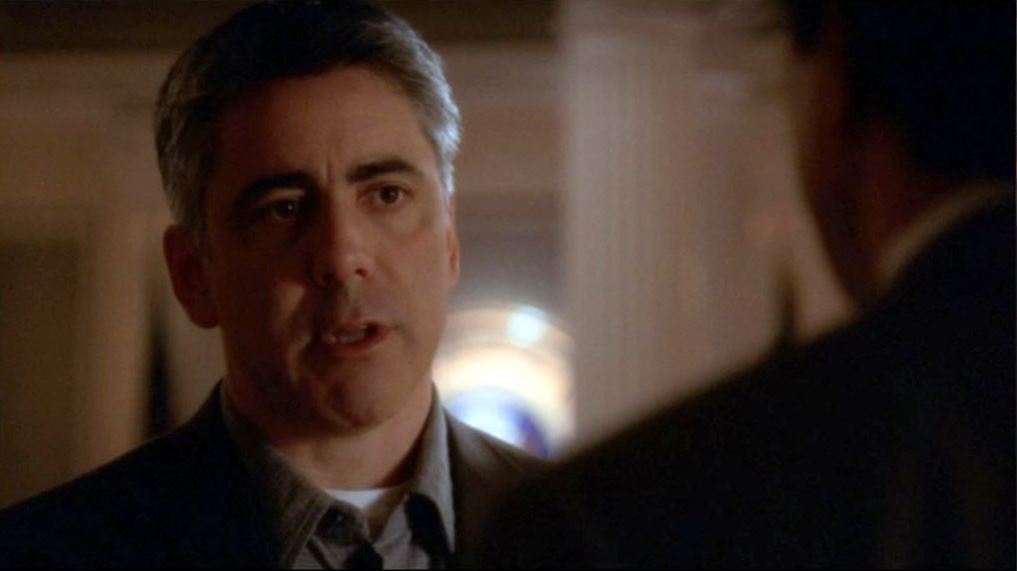
Jed Bartlet sure can't. It's a Friday night, and he hasn't been able to sleep since the tense confrontation between him and Toby that we saw the previous Monday at the end of The Two Bartlets. In desperation, he turns to Dr. Stanley Keyworth - a man we saw help guide Josh through his psychic pain and turmoil in Noël.

Except Stanley doesn't know that's why he's been called. He thinks he's at the White House to meet with Josh again, as a follow-up - but he's puzzled by the constant references to his flight and whether or not he saw anyone he knew on the plane. Sam, Leo, even the driver who brought him from the airport, all of them asked that question. When the penny drops and Stanley realizes it's something else, well ...
Leo: "How was your flight?"
Stanley: "It was fine."
Leo: "Did you know anyone on the plane?"

Stanley (pause): "You ...didn't bring me here to talk to Josh, did you?"
Leo: "No."
Stanley: "Who did you bring me here to talk to?"
And then a voice from the doorway behind him:
"Dr. Keyworth ... did you know anyone on the plane?"


It's a great reveal, and a nice setup throughout the cold open.

The session between the two evolves throughout the episode. Stanley - who as he says is a trauma specialist, not well-versed in sleep disorders - takes a logical approach to eliminating possible reasons why the President can't sleep. When Bartlet (rather knowingly) hits on the real issue - his confrontation with Toby - now the psychiatrist finds himself on familiar ground:
President: "Well, I guess we talked about a lot of things. Who we think the Republican challenger is gonna be, and incumbency and campaign strategy, strategic overview, but the long and short of it is, my father never liked me at all."
Stanley: "Well, at least we're closer to my area now."
President: "Yeah, I thought you'd enjoy that."
As Stanley explores that "complicated" father-son relationship, he ends up at the exact same place as Toby did four nights before - Bartlet's need to earn his late father's approval has weakened his drive to make bold policy moves. Instead, having voters love him and winning elections have become Priority Number One for the President, and the stark difference between that and the President whose name is on Jed's bedroom is causing nearly unbearable stress on his psyche:
Stanley: "I think Lincoln did what he thought was right, even though it meant losing half the country. I think you don't do what you think is right if it means losing Michigan's electoral votes."
Not surprisingly, this angers the President, just as Toby's hitting on that same nerve did. "I'm not trying to get my father to like me," he retorts. Stanley responds with, "Good. Cause that's never, never gonna happen."


And the President actually takes a moment for that to sink in, to realize yes, the doctor is right.


Unlike Stanley's meeting with Josh ("You're too easy a case for me") he's willing to continue meeting with the President, if Jed is ("Use me, don't use me ..."). After he leaves, Jed takes a moment to consider the battles inside his head - his irrational urge to get his dead father to love him, as well as the responsibility of the office passed on from those like Lincoln (and the cigarettes are a nice prop-related reference to that father-son struggle we saw in Two Cathedrals):


We don't end up with a solution at the end of the episode - it doesn't seem like Bartlet will find it much easier to sleep, at least not right away - but Jed is taking definite steps towards reconciling the battles going on in his head. At the very least, he's figured out what they are.

There's actually several interesting, meaty storylines here. The communications staff is finishing up a speech that President Bartlet intends to give at the United Nations, a speech outlining a tougher foreign policy by specifically calling out "the crushing yoke of Islamic fanaticism." A couple of things make this intriguing - naturally, the more open-minded, outward-looking liberal Democrats in Congress aren't thrilled at all with the President of their own party throwing down against Islam; and it's Toby - old-school protest-march dyed-in-the-wool liberal Toby - who's behind the most inflammatory language in the speech. For me, anyway, this stance always struck me as not "in-character" for Toby as we've come to know him. But, I suppose, it certainly does add depth and dimension to that character, and as I'll talk about later on, Aaron Sorkin decided that somebody on the staff needed to take up some kind of post-9/11 clash-of-cultures stand. There's a huge portion of the American viewing audience who have similar feelings now, five months after those devastating attacks ... and Sorkin settled on Toby as the guy to say that out loud on the show.

Also complicating matters is the fact that the strongest voice against the language in the speech is Rep. Andrea Wyatt - who also just happens to be Toby's ex-wife. This leads to a lot of hilarity among the other staff members:
Leo: "You know your wife's going to have something to say about it, though."
Toby: "My ex-wife."
Leo: "Yeah."
Toby: "Why do you call her my wife?"
Leo: "It bothers you."
Toby: "Everything bothers me."
Leo: "Yeah."
Toby: "But you pick that?"
And then when Toby is leaving Leo's office after CJ comes in, she says to him, "Someone's gonna get an ass-kickin' from the missus," which causes Toby to turn back to the door in rage as it closes in his face:


Not to mention Sam calling Toby "baby." (Toby: "You probably want to rethink calling me 'baby,' right?")

But Andy is furious at Toby, and Sam, and anyone who had a hand in writing up this foreign policy position. Toby actually has some solid ground on which to stand, with specifics about why America shouldn't continue to reach out to the Arab world while getting its own hand bitten. When Andy presents an alternate version of the wording sent by members of her committee, he's not pleased with that, either:
Andy: "The speech isn't supposed to be about ideology. It's supposed to be about reality."
Toby: "I think the President will decide what the speech is supposed to be about, but the reality is, the United States of America no longer sucks up to reactionaries, and our staunch allies will know what we mean."
Andy: "We don't have any staunch allies in the Arab world, just reluctant ones. We've a coalition held together with duct tape! A coalition without which we cannot fight!"
Toby: "Nobody's blowing off the coalition, and that coalition will be plenty strong."
Andy: "Oh, when we win?"
Toby: "That's right." 
Andy: "What's Egypt going to think? Or Pakistan?"
Toby: "That freedom and democracy are coming soon to a theatre near them, so get dressed."
It's quite a divide, these opposing ways of thinking, but I do think Sorkin does a pretty good job of covering both sides in the discussion between Toby and Andy. In the end, Toby agrees to take another look at the softer language, so maybe the new Bartlet foreign policy won't be so obstinate after all.

And then there's Sam, apparently kind of a stand-in for Sorkin as a whipping boy for criticism of how Sorkin writes women. I've discussed this topic before (notably in The Crackpots And These Women) as Sorkin has taken many shots through the years over his portrayal of women, their attitudes, and how men view them. A lot of the criticism is warranted, some of it is not (I mean, look at CJ, one of the great characters in dramatic television history), but he just can't resist using his bully pulpit of a national TV show to respond to his detractors.

The topic here is sexual politics and how men and women relate to each other in the workplace. Sam has asked Ainsley to come in to help work out some details in the UN speech. She arrives from a Federalist Society event, wearing a rather fancy evening dress, which causes Sam to blurt, "Hayes, you could make a good dog break his leash." Overhearing that comment is a worker temporarily assigned to the Communications Office, Celia Walton, who later takes Sam to task for what she sees as inappropriate workplace behavior:


Celia: "It was rude, it was inappropriate, and it was offensive."
Sam: "What did I do?"
Celia: "You demeaned her."
Sam: "No, we're friends. It's a completely mature, you know ... besides, she started it."
Celia: "Whatever."
Sam: "Well ... okay." (He starts into his office, then stops, turns, and comes back out) "I wasn't demeaning her. I was complimenting her."
Celia: "She's an Associate White House Counsel and you're complimenting her on her sexuality?"
Sam: "She looked good in that dress I thought."
Looking at this from the year 2020, I agree that a phrase like "you could make a good dog break his leash" isn't exactly appropriate workplace conversation, with perhaps a little leeway for good friends, but really, not in the workplace, fellas. Almost 20 years ago, attitudes were different, but starting to change for the better, and that's where Celia is ahead of her time. Sorkin tries to build a solid foundation to defend her point of view, but he ends up undercutting her totally and making her attitude stick out like a sore thumb when Ainsley basically tells her off:
Celia: "Isn't the point that Sam wouldn't have been able to find another way to be chummy with a woman who isn't sexually appealing?"

Ainsley: "He would be able to, but that isn't the point. The point is that sexual revolution tends to get in the way of actual revolution. Nonsense issues distract attention away from real ones: pay equity, child care, honest-to-God sexual harassment and in this case, a speech in front of the UN General Assembly. So, you (to Sam), 25 percent on the assessments for Category A. You (to Charlie) ... I don't know what your thing is. And you (turning to Celia), stop trying to take the fun out of my day. With that, I'm going to get a cupcake."


I mean, Celia has some good points, for crying out loud ... but Sorkin ends up dismissing them with Ainsley's speech. For Celia, the issue is men unable to see even strong, capable women as something more than their physical appearance. For Ainsley, guys complimenting her looks isn't demeaning at all, it's fun, and what right does Celia have to pour cold water on that? It's certainly a conversation worth having, and certainly would be written differently in 2020 than it was in 2002 ... but I'm not sure Sorkin ended up with the best grasp on the issue.

Then we have CJ involved in an attempt to free a reporter who's been captured by rebels in the Congo. The reporter's boss comes to CJ asking for help, and Leo gets involved as they start negotiations ... or, more precisely, haggling over the payment the rebels will get in return for releasing the American. It's a plotline designed to tug at heartstrings, with the reporter's wife talking about her (young) family with Donna, even as we see CJ get tough with the corrupt Congolese attache:
CJ: "This is a shakedown, so tell us how much money, and where does it go."
Loboko: "The Congolese government doesn't negotiate with murderers." 
CJ: "The Congolese government is a myth."
Loboko (to Leo): "I can't talk to this woman." 
The story comes to a sad ending when Josh brings word that the reporter has been killed in an ambush. And this emotional moment ends up connecting with an earlier scene concerning Donna ...

The arc of Donna restlessly searching for more responsibility, more respect, and more importance in the jobs she's given is one of the longest arcs of the entire series. We haven't seen that much of it yet, perhaps a few comments here and there, but in this episode she gets an outside job offer. While having a drink and catching up with a friend from college, that friend reveals he's starting an internet company covering behind-the-scenes activities in Washington politics. And he wants her to come on board:
Donna: "Well, I...I'm...surprised and I'm flattered, but I'm, you know, not at all qualified."
Casey: "That's not true. You've been Josh Lyman's traffic cop. That's like an M.A. in power brokering. You know the Hill. You know every corner of the White House. You know every pressure point ten miles from the Potomac." 
(He writes something down on a card and slides it to Donna)
Donna: "Is this your operating budget?"
Casey: "It's your starting salary." 


So how does this connect with the reporter killed in Africa? Donna had been sitting with the reporter's wife while negotiations went on, and was standing in the hallway when CJ and the reporter's boss gave her the bad news. As the wife collapses on the floor in grief, Donna looks on sadly:


The camera view changes, and we see Donna's face ... and also Josh, at the other end of the hall, looking on:


Donna turns and sees Josh there, taking in the scene:


I think this is meant to tell us, and Donna, something. Sure, a neat job as Issues Director at a dot-com with a big salary sounds great ... but that means you're not in the middle of things in the White House, helping make life-and-death decisions, helping guide policies that affect countries around the world. You wouldn't be "in the room where it happens," so to speak. And also, it means not working with Josh. I really think both those elements come into play in Donna's mind right here, and I think this scene tells us without words what her answer to Casey Reed is going to be.

So, wow - a lot of meaningful, thought-provoking, serious storylines are covered in this episode. The question often remains, how deep can you really delve into issues in a 48-minute script, especially when it's divided between five different topics? I think in a lot of ways, episodic TV like this can be a starting point for us to think about things like appropriate workplace behavior and how men and women see each other, or how America should view Islam and the Arab world in the aftermath of 9/11, or even how a man's personal emotional history comes to bear in a position of national leadership. I think The West Wing, while perhaps not wrapping everything up in a final conclusion on topics like this, does a really good job of laying out different points of view to get us to think about where we stand, and where we ought to stand. Instead of telling us what to think (which I admit The West Wing can often do), sometimes the show just gives us different ways to think about things. And hopefully we'll be able to get to sleep afterwards.


Tales Of Interest!

- Timeline notes: This episode takes place the same week as The Two Bartlets (it's a Friday, and the President says he's been unable to sleep for four nights, since the night of the Iowa caucuses when he had his confrontation with Toby). Toby also says it's been two weeks since the State of the Union, which was portrayed two episodes ago in 100,000 Airplanes.

- To me, at least, it's really interesting to see the intrusion of real-world events into The West Wing. The September 11 attacks occurred just as the 2001-02 television season was about to begin, and there were probably eight or ten West Wing scripts for Season 3 already written or in process at that time. While Sorkin quickly threw together Isaac And Ishmael in an attempt to acknowledge the reality of how America was coping in the immediate aftermath, it was also made clear that the episode doesn't actually exist within the series' timeline and that there hasn't been any such cataclysmic event occurring in the West Wing universe. There hasn't been any explicit reference to American military action by the Bartlet administration, except for the rare instances like the attack on Syria responding to the shootdown of a plane with medical personnel (A Proportional Response), the attempt to rescue DEA personnel in Colombia (Bartlet's Third State Of The Union / The War At Home), or the standoff with coup leaders in Haiti seen at the end of Season 2. By this time, though, we're seeing scripts that were written in a post-9/11 real world, and there are references and attitudes that only make sense in that regard. I first noticed it in the State of the Union address in 100,000 Airplanes, almost in the background, as the President vowed to track down terrorists in their caves. Now Toby's anger at an Arab world that mostly is an adversary ("They'll like us when we win!") and the mention of America building a fighting "coalition" somewhere in the Middle East are glimpses of the real world and real American attitudes in a post-9/11 atmosphere.

- The West Wing almost always has interesting editing and cinematic direction. I talked about the real inventiveness of shots and composition in The Two Bartlets (directed by Alex Graves), and here Christopher Misiano brings out some cool ideas of his own. I particularly enjoyed the early scene when President Bartlet (in his study) clicks on the closed-circuit feed of CJ's press briefing:


As the President murmurs an answer to a question posed by a reporter ("When do we see copies?" "When we're done writing it."), the scene changes to the briefing room, but CJ is still only seen on the monitors:


And finally we change to a shot of CJ at the lectern, fully transporting the viewer from the President's study into the briefing room:


- Martin Sheen was nominated for an Outstanding Lead Actor in a Drama Series Emmy for this episode, but he would end up losing to Michael Chiklis (The Shield). Richard Schiff's performance here (along with Hartsfield's Landing) earned him his third consecutive Emmy nomination for Outstanding Supporting Actor in a Drama Series. Schiff won the Emmy in 2000 and lost to castmate Bradley Whitford in 2001 - he'd lose to another castmate this year, John Spencer.


Quotes    


Keyworth: "I'm a trauma specialist."
President: "Yeah, we know you. You helped Josh out last year."
Keyworth: "Josh was shot."
President: "Me, too."
Keyworth: "Is that why you can't sleep?"
President: "How would I know?"
Keyworth: "That's a fair point."  
-----
(Toby paces back and forth as Leo looks over the speech)
Leo: "Toby?"
Toby: "Yeah?"
Leo: "Pacing."
Toby: "Yeah."

Leo: "Okay, now the standing still is bothering me a little bit."
-----
Andy: "Where is he?"
Sam: "I don't know."
Andy: "You said that already."
Sam: "But, you asked me again and I still didn't know."
-----
Josh: "You can't be thinking about taking a job that may not be around a year from now?"
Donna: "This job may not be around a year from now."
Josh (considers that a moment): "He offered you money?"
Donna: "Yeah."
Josh: "Well, all I can offer you is a title bump."
Donna: "Like what?"
Josh: "Senior Assistant to the Deputy Chief of Staff for Strategic Planning."
Donna: "That's my title now."
Josh: "Then I can't offer you a title bump."
-----
Toby: "We do know what's right."
Andy: "This is why they hate us."
Toby: "There's a lot of reasons why they hate us. You know when they're gonna like us? When we win."
-----
Toby: "How about when we sent American soldiers to protect Saudi Arabia, and the Arab world told us we were desecrating their holy land? We'll ignore the fact that we were invited. How about two weeks ago, in the State of the Union when the President praised the Islamic people as faithful and hardworking only to be denounced in the Arab press as knowing nothing about Islam? But none of that is the point."
Andy: "What is the point?"
Toby: "I don't remember having to explain to Italians that our problem wasn't with them, but with Mussolini. Why does the U.S. have to take every Arab country out for an ice cream cone? They'll like us when we win!"
-----
Stanley: "We're done for the night."
President (taken aback): "What?" 
Stanley: "We've been here for two hours. It was a double session. We're done for the night."
President: "Stanley, I hate to put it this way, but I'm me, and you're you, and we're done when I say we're done."
Stanley: "No. (beat) I think you could use some assistance right now, sir. Use me, don't use me, but all I can offer you is this: I'll be the only person in the world, other than your family, who doesn't care that you're the President. Our time is up." 


Story threads, callbacks, and familiar faces (Hey, it's that guy!)
  • Dr. Stanley Keyworth of the American Trauma Victims Association, played by Adam Arkin, returns. We saw him in the Season 2 Christmas episode (Noël) as he helped Josh work through his PTSD from being shot at Rosslyn.

  • Ainsley Hayes is back! The wonderful Emily Procter hasn't been seen since Ways And Means, when she was setting up Donna and Cliff Calley on a date (and we know how that worked out).

  • And Toby's wife - er, sorry, ex-wife - Representative Andy Wyatt (Kathleen York) appears for the third time. She was last seen in a short scene in Ellie.

  • There's obvious callbacks to the Rosslyn shootings seen in In The Shadow Of Two Gunmen (when the President tells Dr. Keyworth he was shot, too) and Josh's visit with Stanley in Noël.
  • The "complicated" relationship Jed had with his father - and his ongoing need to try to win his approval retroactively - was first explored in Two Cathedrals and then prodded at by Toby in The Two Bartlets.
  • Charlie said his sister was named "Deena" in A Proportional Response. Here he calls her "Deanna."
  • We see a photograph of Jed's father, whom we saw in Two Cathedrals (played by Lawrence O'Donnell).
  • WHAT'S NEXT MOMENT - This isn't exactly a "What's next?" moment, but it's similar - at one point Stanley tells the President, "This is a hell of a curve you get graded on now. Lincoln freed the slaves and won the Civil War. 'Thank you. Next! And what will you be singing for us today, Mr. Bartlet?'"


DC location shots    
  • None

They Do Exist! It's The Real Person, or Thing    
  • For the second episode in a row, former CNN anchor Bobbie Battista appears on a TV in the background. To be honest, this might be the exact same clip they used in The Two Bartlets.

  • Ainsley tells Sam she left an event for the Federalist Society to come help him with the UN speech.  
  • Andy satirically wonders if the old-time comedy duo Abbott and Costello are behind the administration's foreign policy speech.
  • We get a mention of the International Herald Tribune, which was a real newspaper (headquartered in Paris and jointly owned by the Washington Post and the New York Times) devoted to coverage of world events. Publishing under that name ended in 2013, and as of 2016 the paper is now called The New York Times International Edition.
  • Toby's rant against the Arab world for some reason brings in the World War II Italian dictator Benito Mussolini.
  • Of course President Lincoln plays a large role at the end of the episode, with the weight of comparisons between him and President Bartlet.
  • PRODUCT - Donna's friend Casey Reed is drinking Amstel Light at the bar. There were also fleeting glimpses of a couple of other liquor bottles, including what looks to be Johnny Walker Red scotch (what, they didn't have any Johnny Walker Blue left over from Bartlet For America?).


End credits freeze frame: The final shot of President Bartlet staring out the window of his study.